boys (), no two of them having the same height, are arranged along a circle. A boy in the given arrangement is said to be tall if he is taller than both of his neighbors.
Find all possible numbers of tall boys in the arrangement.
Belorusija, 2012
Solution
Answer: any integer number from to .
Consider arbitrary arrangement of the boys along the circle. We put the signs "+" or "-" before any boy in accordance with the following rule: we move clockwise along the circle and put the sign "+" before the boy if he is taller than the previous boy and we put the sign "-" if he is shorter than the previous one. It is evident that the boy is tall if and only if the sign "+" stands before him and the sign "-" stands after him. (Note that since the tallest boy among all boys is tall, there exist the signs "+" as well as the signs "-" in any arrangement.) Therefore, the number of tall boys in the arrangement is equal to the number of alternations of "+" and "-". It is evident that the number of these alternations is less than or equal to .
Now we show that for any , , there exists an arrangement with exactly tall boys.
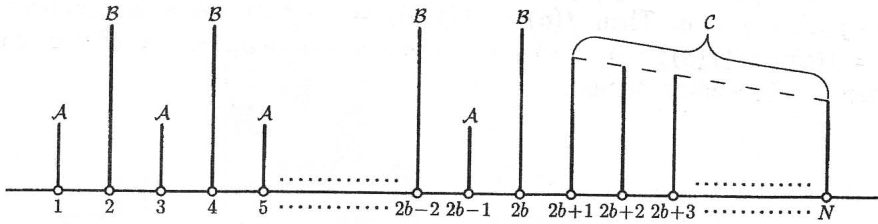
We number all boys in accordance with their heights: the shortest boy has the number , and the tallest boy has the number . We partition all boys into three groups , and : group contains the shortest boys, i.e. the boys with the numbers ; group contains the tallest boys, i.e. the boys with the numbers (since , i.e. , there exists such partition); finally, group consists of all remaining boys (if is even and , then is empty).
We also number the places on the circle with numbers from to . We place the boys from on the places with the numbers , ; the boys from are placed on the places with the numbers , ; the boys from are placed on the remaining places (with the numbers ) so that the boy with the number is placed on the place with the number , the boy with the number is placed on the place with the number (see the fig.). It is easy to see that there exist exactly tall boys in this arrangement.
Want a route through all this instead of an archive? The track
puts 2,604 problems in a working order, from Junior Challenge level to the IMO shortlist.