Let be a real number satisfying the property: For any nonnegative real numbers with their sum equal to , it is possible to arrange them around a circle such that the products of any two neighboring numbers are no greater than . Determine the minimum value of .
Selection tests for the Balkan Mathematical Olympiad, 2013
Solution
Assume, without loss of generality, that
Because
to get the smallest possible maximum, the best arrangement around the circle is
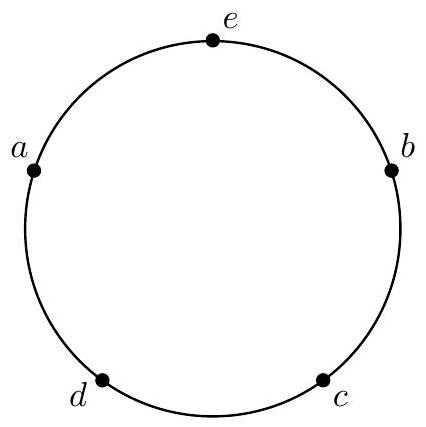
In this case, the maximum is given by
We have
and the equality holds when , , and .
We have, on the other hand,
and the equality holds when , and .
Therefore, the minimum possible value of is .
Want a route through all this instead of an archive? The track
puts 2,604 problems in a working order, from Junior Challenge level to the IMO shortlist.