is a cyclic quadrilateral such that . Diagonals and intersect at . Given that and , find the possible values of .
Selection tests for the Balkan Mathematical Olympiad, 2013
Solution
Applying Ptolemy relation to the cyclic quadrilateral , we get
which simplifies to
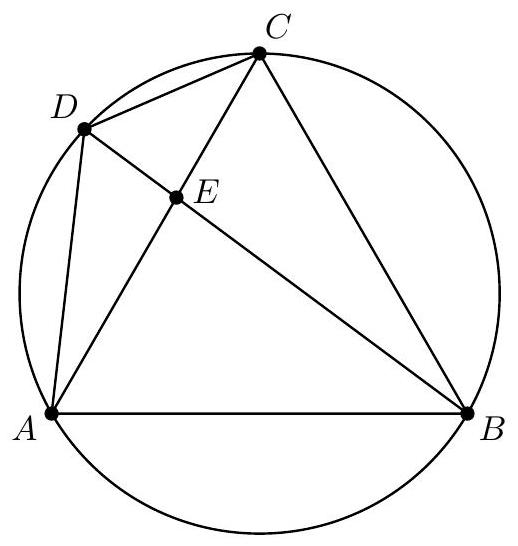
Let and .
We have, from similarity of triangles and , that
We have, from similarity of triangles and , that
We deduce that
and therefore .
Applying sine law on the circumcircle of , we obtain
Hence , that is
Applying cosine law to triangle , we obtain
and therefore, or .
Want a route through all this instead of an archive? The track
puts 2,604 problems in a working order, from Junior Challenge level to the IMO shortlist.