a) Consider cases of the location of the vertex angle of the triangle BCF (Fig. 27).
If F were the apex, then F would lie on the perpendicular bisector of the side BC, i.e., on the line AD, whence F=A. Therefore AC would be a tangent of the incircle of the triangle ABD. But the lines AB and AD are tangents of the same circle. There can be at most two tangents drawn from one point to one circle. Hence this case is impossible.
Let B be the apex. As CBF is a base angle of the isosceles triangle ABC, we have ∠CBF<90∘. Hence ∠BCF>45∘. Let K be the tangent point of the line CF and the incircle of the triangle ABD and let L be the projection of the point K onto the line BC. By construction, KL<2r, where r is the radius of the incircle
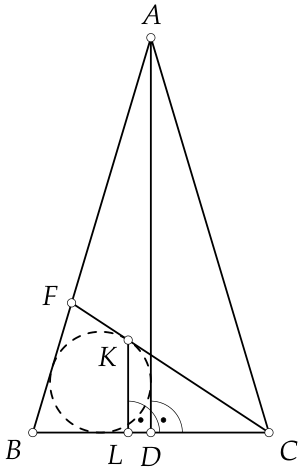
Fig. 27
of the triangle ABD. On the other hand, ∠LCK=∠BCF>45∘ implies KL>CL>CD=BD>2r. Hence this case is impossible, too.
This shows that the apex of triangle BCF can only be C.
b) Let the apex be C. Fix a point D, mutually perpendicular lines l1 and l2 both passing through C, and circle c that is tangent to both lines; let the radius of the circle be r. Choose point A on l1 in such a way that DA>2r and the tangent point of line l1 and circle c lies on the line segment DA. Point B is determined by the location of A as the point of intersection of line l2 and the second tangent line of circle c passing through A, point C is symmetric to B w.r.t. DA and F is defined as in the problem. When point A moves away from D, points B and C get closer to D, whence ∠BAC decreases and ∠BCF increases. Thus these angles can equal only in one case.