Maths Olympiad Prep

Library / /12 of 42

Geometry Difficulty 5.2 AIME, harder Prove it Ireland

Let ABCDABCD be a square and let Γ\Gamma denote the circle with diameter CDCD. A tangent line is drawn to the circle Γ\Gamma from BB, meeting the circle Γ\Gamma at EE and intersecting the segment ADAD at KK.
Prove that AD=4KD|AD| = 4|KD|.

Solutions — 5

Solution 1

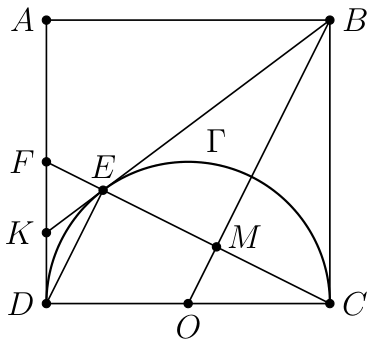
Let OO be the midpoint of CDCD, the centre of circle Γ\Gamma. Let FF be the point where line CECE meets ADAD, and let CECE meet OBOB at MM.
Figure 1
Angle DEC\angle DEC is standing on the diameter CDCD of Γ\Gamma, hence is a right angle. Therefore, triangle DEFDEF has a right angle at EE. The two tangents KDKD and KEKE of Γ\Gamma have the same length: KD=KE|KD| = |KE|. This implies that KK is on the perpendicular bisector of DEDE and so must be the circumcentre of triangle DEFDEF. Therefore, KK is the midpoint of DFDF.
Because BCBC and BEBE are tangents to Γ\Gamma, we have BE=BC|BE| = |BC|. Hence BEMBCM\triangle BEM \equiv \triangle BCM, with BME=BMC=90\angle BME = \angle BMC = 90^\circ. Since BC=CD|BC| = |CD| and MBC=90BCM=FCD\angle MBC = 90^\circ - \angle BCM = \angle FCD we get FCDOBC\triangle FCD \equiv \triangle OBC. Thus FD=OC=12AD|FD| = |OC| = \frac{1}{2}|AD| and DK=12FD=14AD|DK| = \frac{1}{2}|FD| = \frac{1}{4}|AD|.

Solution 2

Let KOKO meet DEDE at NN and let BOBO meet ECEC at MM.
The right angled triangles BOEBOE and BOCBOC are congruent since they share the hypotenuse and OE=OC|OE| = |OC| (radii). As a consequence, EMBCMB\triangle EMB \equiv \triangle CMB by SAS. This shows that OBOB is the perpendicular bisector of ECEC. Similarly, OKOK is the perpendicular bisector of DEDE. Hence EMONEMON is a rectangle and
KDODNOENOOMEOMCOCB. \triangle KDO \sim \triangle DNO \equiv \triangle ENO \equiv \triangle OME \equiv \triangle OMC \sim \triangle OCB.
Thus KDOD=OCCB=12\frac{|KD|}{|OD|} = \frac{|OC|}{|CB|} = \frac{1}{2} and finally AD=2OD=4KD|AD| = 2|OD| = 4|KD|.

Solution 3

We let ϕ=OBC\phi = \angle OBC. Then tanϕ=OCBC=12\tan \phi = \frac{|OC|}{|BC|} = \frac{1}{2}. The right angled triangles OBEOBE and BOCBOC are congruent, because they share the hypotenuse and OE=OC|OE| = |OC| (radii of Γ\Gamma). Consequently ϕ=OBC=OBE=12EBC\phi = \angle OBC = \angle OBE = \frac{1}{2}\angle EBC. The double angle formula for tan then gives
tan(EBC)=tan(2ϕ)=2tanϕ1tan2ϕ=43. \tan(\angle EBC) = \tan(2\phi) = \frac{2 \tan \phi}{1 - \tan^2 \phi} = \frac{4}{3}.
As ABK=90EBC\angle ABK = 90^\circ - \angle EBC, we obtain
AKAB=tan(ABK)=1tan(EBC)=34. \frac{|AK|}{|AB|} = \tan(\angle ABK) = \frac{1}{\tan(\angle EBC)} = \frac{3}{4}.
It follows that AK=34AD|AK| = \frac{3}{4}|AD| and so AD=4DK|AD| = 4|DK|.

Solution 4

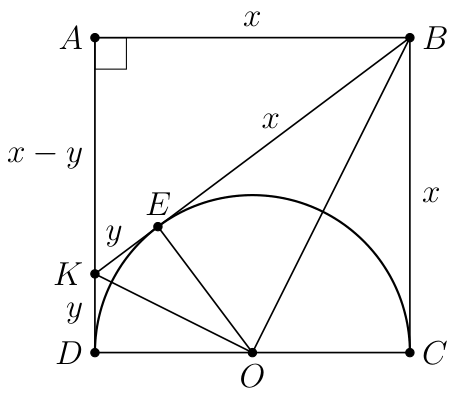
We have BC=BE|BC| = |BE| (tangents from BB) and KE=KD|KE| = |KD| (tangents from KK). We let x=BE=BC=ABx = |BE| = |BC| = |AB| and y=KE=KDy = |KE| = |KD|.
Figure 2
Triangle ABKABK has a right angle at AA and Pythagoras' Theorem gives
(x+y)2=BK2=AB2+AK2=x2+(xy)2. (x + y)^2 = |BK|^2 = |AB|^2 + |AK|^2 = x^2 + (x - y)^2.
This simplifies to 4xy=x24xy = x^2, hence x=4yx = 4y.

Solution 5

Let the vertices of the square be A(1,2)A(-1, 2), B(1,2)B(1, 2), C(1,0)C(1, 0), D(1,0)D(-1, 0), so that x2+y2=1x^2 + y^2 = 1 is the circle in question. If x02+y02=1x_0^2 + y_0^2 = 1, the line LL with equation xx0+yy0=1xx_0 + yy_0 = 1 is a tangent to the circle at E(x0,y0)E(x_0, y_0). It passes through BB iff 2y0+x0=12y_0 + x_0 = 1. Solving the equations
2y0+x0=1,x02+y02=1 2y_0 + x_0 = 1, \quad x_0^2 + y_0^2 = 1
we get (x0,y0)=(35,45)(x_0, y_0) = (-\frac{3}{5}, \frac{4}{5}) or (x0,y0)=(1,0)(x_0, y_0) = (1, 0), and EE is the first of these. Hence LL has equation 4y3x=54y - 3x = 5. This line LL meets the line x=1x = -1 at K(1,12)K(-1, \frac{1}{2}), whose distance from D(1,1)D(-1, 1) is 12=14AD\frac{1}{2} = \frac{1}{4}|AD|.

Want a route through all this instead of an archive? The track puts 2,000 problems in a working order, from AMC 10 level to the IMO shortlist.

Source: MathNet, licensed CC-BY-4.0. Statement and solution reproduced as published; topic and difficulty added by this site.