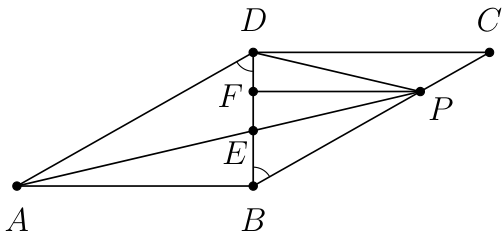
A parallelogram ABCD is such that BD⊥AB. A point P on BC is such that ∣PD∣=∣BE∣ where E is the intersection point of BD and AP. The point F is the foot of the perpendicular from P to BD. Prove ∣PF∣∣AB∣=2.
Solution
From the construction we have ∣EF∣=∣FD∣ and FP is parallel to AB. It follows that △ABE is similar to △PFE, hence ∣PF∣∣AB∣=∣EF∣∣BE∣(2)
Because BC∥AD, the angles ∠FBP and ∠BDA are equal. This implies that the right angled triangles △ABD and △PFB are similar, and so ∣PF∣∣AB∣=∣BF∣∣BD∣=∣BE∣+∣EF∣∣BE∣+2⋅∣EF∣(3)
Combining (2) and (3) we get ∣EF∣∣BE∣=∣BE∣+∣EF∣∣BE∣+2⋅∣EF∣, i.e.∣BE∣2+∣BE∣⋅∣EF∣=∣BE∣⋅∣EF∣+2⋅∣EF∣2which gives∣BE∣2=2⋅∣EF∣2. Using (2) we now obtain ∣PF∣∣AB∣=∣EF∣∣BE∣=2.
Want a route through all this instead of an archive? The track
puts 2,604 problems in a working order, from Junior Challenge level to the IMO shortlist.
Source: MathNet,
licensed CC-BY-4.0.
Statement reproduced verbatim; metadata (topic, difficulty) added by this project.