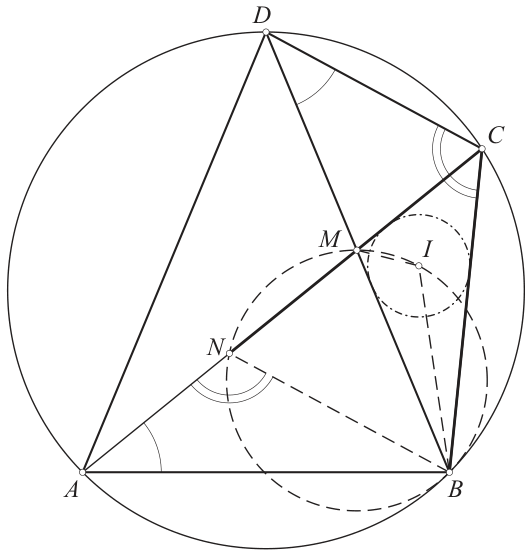
Let ABCD be a cyclic quadrilateral such that ∣AD∣=∣BD∣ and let M be the intersection of its diagonals. Let N be the second intersection of the diagonal AC with the circle passing through B, M and the incentre of the triangle BCM. Prove that ∣AN∣⋅∣NC∣=∣CD∣⋅∣BN∣.
Solution
We denote ∠BAD=∠DBA=α in the isosceles triangle ABD. Then ∠ACB=∠ADB=180∘−2α. Let I be the incentre of the triangle BCM. We have ∠MIB=180∘−21(∠BMC+∠CBM)=180∘−21(180∘−∠MCB)=180∘−21(180∘−∠ACB)=180∘−α. Since the quadrilateral BIMN is cyclic we can prove that ∠BNC=α (independently of the position of the point N) so the triangle BCN is isosceles and ∣BC∣=∣NC∣.
Note that the triangles ABN and DBC are similar because ∠ANB=∠DCB=180∘−α and ∠BAN=∠BDC (suspended angles over the chord BC). Hence ∣BN∣∣NA∣=∣BC∣∣CD∣=∣NC∣∣CD∣, i.e. ∣AN∣⋅∣NC∣=∣CD∣⋅∣BN∣.
Want a route through all this instead of an archive? The track
puts 2,604 problems in a working order, from Junior Challenge level to the IMO shortlist.
Source: MathNet,
licensed CC-BY-4.0.
Statement reproduced verbatim; metadata (topic, difficulty) added by this project.