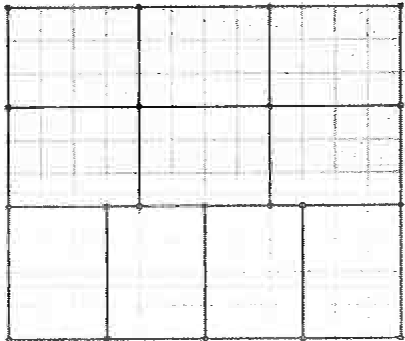
An investor has two rectangular lands, each of size 120×100.
a. On the first land, she wants to build a house with a rectangular base of size 25×35 and nine circular flower pots with diameter 5 outside the house. Prove that for all positions of the flower pots, the remaining land is still sufficient to build the desired house.
b. On the second land, she wants to construct a polygonal fish pond such that the distance from an arbitrary point on the land, outside the pond, to the nearest pond edge is not over 5. Prove that the perimeter of the pond is not smaller than 440−202.
Solution
a. Consider the rectangle ABCD where AB=CD=120 and AD=BC=100. Divide the rectangle into 10 sub-rectangles of size 30×40 as shown below. Consider 9 centers of the flower pots. By the pigeonhole principle, it is clear that there exists a sub-rectangle that does not contain any center.
Suppose that rectangle is XYZT where XY=ZT=40, XT=YZ=30. Consider one more rectangle X′Y′Z′T′ lying inside XYZT such that the sides of two rectangles are pairwise parallel and the gaps are equal to 2.5.
It is easy to check that X′Y′Z′T′ does not share any point with the pots so we can build a house on this plot.
b. Consider a rectangle ABCD where AB=CD=120 and AD=BC=100. Let L be the perimeter of the lake. According to the problem, there exist points A′, B′, C′, D′ in L such that AA′,BB′,CC′,DD′≤5. Since the lake is a convex polygon, then A′B′, B′C′, C′D′ and D′A′ do not overlap. Hence, ∣L∣≥A′B′+B′C′+C′D′+D′A′. Denote A1 as the projection of A′ to AD and A2 as the projection of A′ to AB. Similarly, we can define B1, B2, C1, C2, D1, D2 and we have A1A′+A′B′+B′B1≥A1B1≥AB=120. Similarly, we also have B2B′+B′C′+C′C2≥100, C1C′+C′D′+D′D1≥120, D2D′+D′A′+A′A2≥100. Hence, A′B′+B′C′+C′D′+D′A′+(A′A1+A′A2+B′B1+B′B2+C′C1+C′C2+D′D1+D′D2)≥440. Finally, applying the Cauchy-Schwarz inequality, we have A′A1+A′A2≤2(A′A12+A′A22)=2A′A22≤52. Similarly, we also have B′B1+B′B2≤52,C′C1+C′C2≤52,D′D1+D′D2≤52. From these inequalities, it is clear that the length of L does not exceed 440−202. □
Want a route through all this instead of an archive? The track
puts 2,604 problems in a working order, from Junior Challenge level to the IMO shortlist.
Source: MathNet,
licensed CC-BY-4.0.
Statement reproduced verbatim; metadata (topic, difficulty) added by this project.