Given a circumcircle O and two fixed points B,C on O (BC is not the diameter of O). A point A is moving on O such that ABC is an acute triangle. Let E,F be the feet of the altitudes from B,C of triangle ABC. Let I be an arbitrary circle passing through E and F.
a) Let I touch BC at D. Prove that DCDB=cotCcotB.
b) Suppose that I intersects BC at M and N. Let H be the orthocenter of triangle ABC and P,Q be the intersections of I and the circumcircle of triangle HBC. Let K be the circle passing through P,Q and touches O at T (T is on the same side with A with respect to PQ). Prove that the interior angle bisector of ∠MTN passes through a fixed point.
Solution
In case AB=AC, it is obvious that DB=DC and the bisector of ∠MTN passes through the midpoint of the minor arc BC of O (which is the fixed point that is revealed in part b), hence we only need to consider the case where AB=AC.
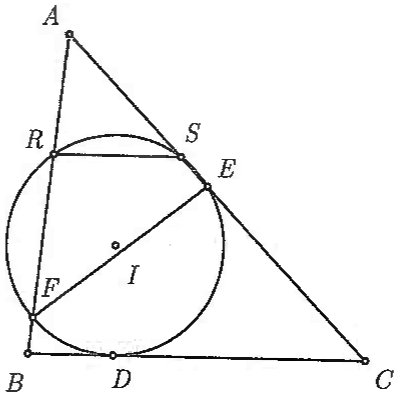
a) Let R,S be the second intersections of I with AB,AC respectively. Since E,F lie on a circle with diameter BC, and quadrilateral EFRS is cyclic, we conclude BC∥RS by Reim's theorem.
By the assumption, I touches BC at D then CD2BD2=CE⋅CSBF⋅BR=CE⋅CSBF⋅BR=CE⋅ACBF⋅AB=CE⋅CFBF⋅BE=cotCcotB which means CDBD=cotCcotB.
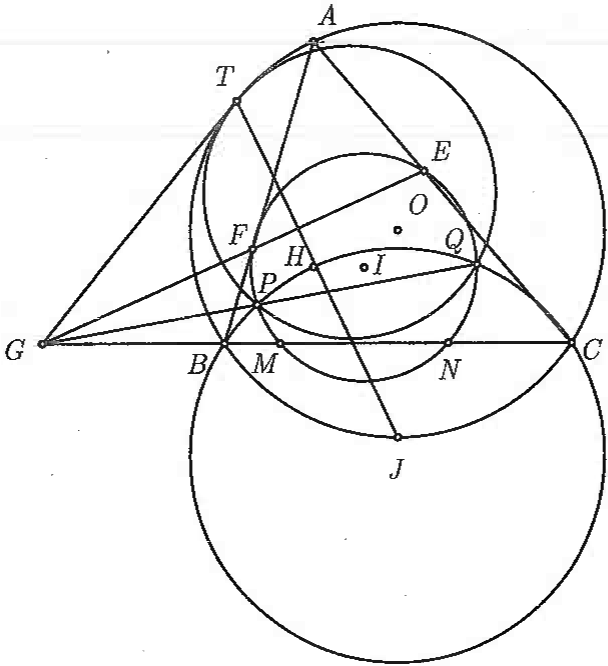
b) Denoted by G the intersection of EF and BC. We have * The radical axis of (BHC) and I is PQ, * The radical axis of I and (BFCE) is EF, * The radical axis of (BHC) and (BFCE) is BC.
Hence G is the radical center of these circles, which means G lies on PQ. On the other hand, we have * Let the radical axis of O and (TPQ) be d, * The radical axis of (TPQ) and (BHC) is PQ, * The radical axis of (BHC) and O is BC.
then d, PQ and BC concur at G which means GT is the radical axis of O and (TPQ), hence GT touches (TPQ) and O. Since PQMN is a cyclic quadrilateral, GM⋅GN=GP⋅GQ=GT2, hence GT touches (TMN).
In conclusion, (TMN) touches O at T, we conclude that TM,TN are isogonal with respect to ∠BTC then the bisector of ∠MTN is coincident with the bisector of ∠BTC, which passes through J, the midpoint of minor arc BC of O. □
Want a route through all this instead of an archive? The track
puts 2,604 problems in a working order, from Junior Challenge level to the IMO shortlist.
Source: MathNet,
licensed CC-BY-4.0.
Statement reproduced verbatim; metadata (topic, difficulty) added by this project.