Let be a triangle such that . Point lies on the altitude drawn from vertex and point is chosen on the line in such a way that . Prove that if then point lies on the bisector of the external angle on vertex of triangle .
Estonian Math Competitions
Solutions — 3
Solution 1
As and (Fig. 11), we have . As and are both right angles, points and lie on circle with diameter . By inscribed angles, . On the other hand, and, by symmetry of isosceles triangle, . Consequently, , implying that bisects the internal angle on vertex of the triangle . As is right angle, bisects the corresponding external angle.
Solution 2
The altitude drawn from the vertex angle of the isosceles triangle is the perpendicular bisector of its base. All points of the perpendicular bisector of a line segment lie at equal distance from the endpoints of the line segment, implying that . As and , we conclude .
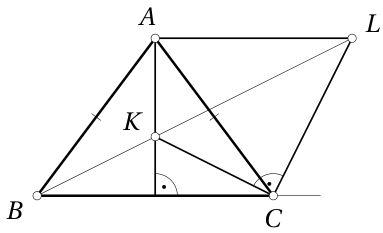
Fig. 11
Let be a point on line such that is between and , and let lines and intersect at (Fig. 12). As and , triangles and are similar. Together with the equality , it implies . Thus is the altitude drawn from the vertex angle of the isosceles triangle , implying also . Hence is the midpoint of the hypotenuse of the right triangle , implying that is the center of the circumcircle of the triangle . Consequently, , implying that , i.e., bisects the external angle on vertex of the triangle .
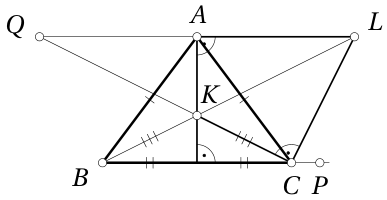
Fig. 12
Solution 3
When point moves along the altitude drawn from vertex of the triangle farther from point , the angle decreases, while point also moves farther from point , causing the angle to increase. Thus the difference also increases in this process and can equal in the case of exactly one location of point . Hence it suffices to show that if lies at the bisector of the external angle on vertex of the triangle then .
So let lie at the bisector of the external angle on vertex of the triangle (Fig. 13). As and , we have ; as is the altitude drawn from the vertex angle of the triangle , it bisects the vertex angle, whence also lies on the bisector of the external angle on vertex of the triangle . Thus is the center of the excircle tangent to side of the triangle and lies also on the bisector of the internal angle on vertex of the triangle . Hence both and are angle bisectors, implying that is the intersection point of angle bisectors of the triangle and is the bisector of the internal angle on vertex of the triangle . Consequently, and are perpendicular.
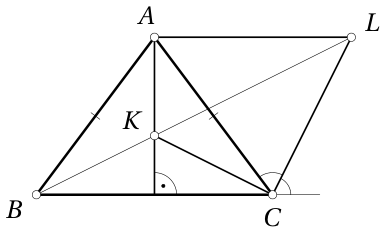
Fig. 13
Want a route through all this instead of an archive? The track
puts 2,604 problems in a working order, from Junior Challenge level to the IMO shortlist.