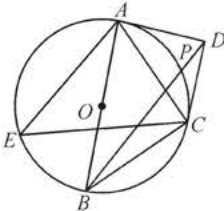
As shown in Fig. 1, ABCD is a convex quadrilateral with ∠B+∠D<180∘, and P is a moving point on the plane. Let f(P)=PA×BC+PD×CA+PC×AB. (1) Prove that P, A, B, C are concyclic when f(P) reaches the minimum.
(2) Suppose that point E is on the arc AB of the circumscribed circle O of △ABC, satisfying ABAE=23,ECBC=3−1,∠ECB=21∠ECA; furthermore, DA, DC are tangent to ⊙O, AC=2. Find the minimum of f(P).
Fig. 1
Solutions — 3
Solution 1
(1) As shown in Fig. 1, by the Ptolemy inequality we have PA×BC+PC×AB≥PB×AC. Therefore, f(P)=PA×BC+PC×AB+PD×CA≥PB×CA+PD×CA=(PB+PD)×CA. The equality holds if and only if P, A, B, C lie on ⊙O and P on AC. Furthermore, PB+PD≥BD, and the equality holds if and only if P lies on line BD. Combining the results above, we have f(P)min=BD×CA.
(2) Denote ∠ECB=α. Then ∠ECA=2α. By the sine theorem we have ABAE=sin3αsin2α=23. That is to say, 3sin3α=2sin2α. By using trigonometric identities, 3(3sinα−4sin3α)=4sinαcosα. By simplification, 33−43(1−cos2α)−4cosα=0. That is to say, 43cos2α−4cosα−3=0. The solutions are cosα=23 and cosα=−231 (discarded). Therefore, α=30∘ and ∠ECA=60∘. On the other hand, ECBC=3−1=sin∠EACsin(∠EAC−30∘). That is to say, 23sin∠EAC−21cos∠EAC=(3−1)sin∠EAC. Then 22−3sin∠EAC=21cos∠EAC. Therefore, tan∠EAC=2−31=2+3. We obtain ∠EAC=75∘ and ∠AEC=45∘. Since △ADC is an isosceles triangle and AC=2, we have CD=1. Furthermore, △ABC is an isosceles triangle, so BC=2 and AB=2. Then BD2=AB2+AD2=4+1=5. We have BD=5. Therefore, f(P)min = BD × CA = 5×2=10.
Solution 2
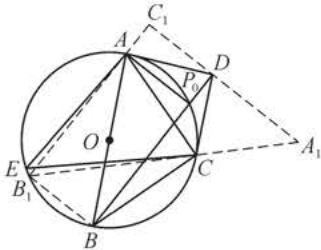
(1) As shown in Fig. 2, the line BD intercepts the circumscribed circle O of △ABC at point P0, which lies on BD because D is outside of ⊙O. Through A, C, D draw lines perpendicular to P0A, P0C, P0D, respectively, and they constitute △A1B1C1 by intercepting with each other. It is easy to see that P0 lies in △ABC, as well as in △A1B1C1. Denoting the three inner angles of △ACD by x, y, z, respectively, we have Fig. 2 ∠AP0C=180∘−y=z+x. Furthermore, from B1C1⊥P0A and B1A1⊥P0C, we have ∠B1=y. In a similar way, we have ∠A1=x and ∠C1=z. It follows that △A1B1C1∼△ABC. Now let B1C1=λBC,C1A1=λCA,A1B1=λAB. Then for any point M on the plane, we have λf(P0)=λ(P0A×BC+P0D×CA+P0C×AB)=P0A×B1C1+P0D×C1A1+P0C×A1B1=2S△A1B1C1≤MA×B1C1+MD×C1A1+MC×A1B1=λ(MA×BC+MD×CA+MC×AB)=λf(M). That is to say, f(P0)≤f(M). Since M is an arbitrary point, we know that f(P) reaches the minimum at P0, and at the same time P0A, P0C, P0D are concyclic. This completes the proof.
(2) From (1) we know that the minimum of f(P) is f(P0)=λ2S△A1R1C1=2λS△ABC. In the same way as is shown in the proof of (2) in Solution I, we find that both △ADC and △ABC are right-angled isosceles triangles; so we have CD=AD=2AC=1, AB=2AC=2, S△ABC=1, BD=AB2+AD2=5. Furthermore, since △A1B1C1∼△ABC, ∠AB1B=∠AB1C+∠BB1C=90∘, AB1BD is a rectangle. It follows that B1C1=BD=5. Therefore λ=25 and f(P)min = 2 ×25× 1 = 10.
Solution 3
(1) We discuss the problem on the complex plane, and regard points A, B, C as complex numbers. Then by the triangle inequality we have ∣PA⋅BC∣+∣PC⋅AB∣≥∣PA⋅BC+PC⋅AB∣. That is to say, ≥===∣(A−P)(C−B)∣+∣(C−P)(B−A)∣∣(A−P)(C−B)+(C−P)(B−A)∣∣−P×C−A×B+C×B+P×A∣∣(B−P)(C−A)∣∣PB⋅AC∣.(1) Then ≥==∣PA⋅BC∣+∣PC⋅AB∣+∣PD⋅AC∣∣PB⋅AC∣+∣PD⋅AC∣(PB+PD)⋅AC∣BD∣⋅AC∣.(2) The equality in (1) holds only when the complex numbers (A−P)(C−B) and (C−P)(B−A) are in the same direction. This means that there is a real λ>0 such that (A−P)(C−B)=λ(C−P)(B−A). That is to say, C−PA−P=λC−BB−A. Therefore, arg(C−PA−P)=arg(C−BB−A), which means that the angle of rotation from PC to PA is equal to that from BC to AB. It follows that P, A, B, C are concyclic. The equality in (2) holds only when B, P, D are collinear and P lies on the segment BD. This means that f(P) reaches the minimum when P lies on the circumscribed circle of △ABC and P, A, B, C are concyclic.
(2) From (1) we know that f(P)min=BD×CA. The following steps are the same as those in the proof of (2) in Solution I.
Want a route through all this instead of an archive? The track
puts 2,604 problems in a working order, from Junior Challenge level to the IMO shortlist.
Source: MathNet,
licensed CC-BY-4.0.
Statement reproduced verbatim; metadata (topic, difficulty) added by this project.