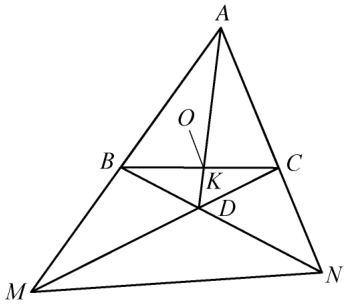
By reduction to absurdity, assume that A,B,D,C are not concyclic. Let the circumcircle (with radius r) of ABC intersect AD at point E. Join BE and extend it to intersect line AN at point Q; join CE and extend it to intersect AM at P. Join PQ, as seen in Fig. 1.2.
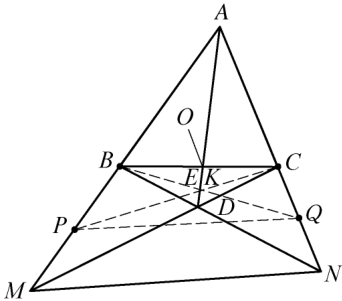
Fig. 1.2
We have
PK2=the power of P with respect to ⊙O+the power of Q with respect to ⊙O=(PO2−r2)+(KO2−r2).
(We will prove it in the appendix)
In the same way,
QK2=(QO2−r2)+(KO2−r2).
Then we have
PO2−PK2=QO2−QK2.
Therefore, OK⊥PQ. By the given condition OK⊥MN, we get that PQ∥MN. Then we have
QNAQ=PMAP.1◯
By Menelaus' Theorem, we obtain
BDNB⋅EADE⋅QNAQ=1,2◯
CDMC⋅EADE⋅PMAP=1.3◯
From ①, ②, ③, we get BDNB=CDMC, or BDND=DCMD. Then △DMN∼△DCB, which implies ∠DMN=∠DCB. Then BC∥MN. Therefore, OK⊥BC, and that means K is the midpoint of BC, which is a contradiction. This completes the proof that A,B,D,C are concyclic.