Ten points are marked in the plane so that no three of them lie on the same straight line. All points are connected with segments. Each of these segments is painted one of the colors.
For what positive integer () is it possible to paint the segments so that for any of the given 10 points there are segments with the ends at these points, all of these segments being painted different colors?
Belorusija, 2012
Solution
Answer: .
First we show that for the required colouring does not exist.
1. There is nothing to prove for and .
2. Let . Consider one (say ) of these 10 points. We have 3 colours and 9 segments connecting with other points. So there are two segments (say and ) having the same colour. Therefore, the edges of the graph with vertices , , and are painted at most 2 colours, thus the required colouring does not exist.
3. Let . Suppose that there is a point such that at least 4 segments (say, , , , and , see Fig. 1) have the same colour (call it blue). Then among the segments connecting points , , , and there is at least one blue segment (say, ). In this case, there are four blue segments , , , and we have to use three different colours to paint two segments and , which is impossible.
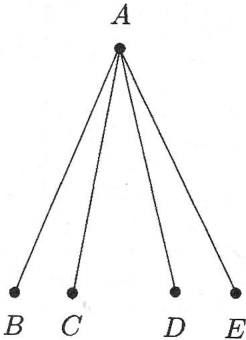
Fig. 1
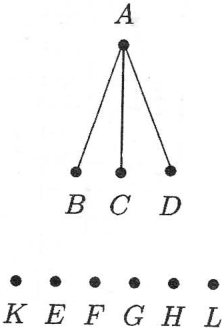
Fig. 2
Hence if the required colouring is possible, then at most 3 segments from any point have the same colour. This yields that for any point (take one of them, say, ) there is a colour (say, blue) such that there are exactly three (say, , , , see Fig. 2) blue segments from . Then none of the segments , , is blue, otherwise , , , would give a contradiction. For any three points of points , , , , and among the segments connecting these three points there is a blue segment, otherwise there is no blue segment among the segments connecting and these three points. (This is a variant of the well-known lemma: among any six persons there are either three pairwise acquainted or three pairwise not acquainted.) Thus there are three points (say, , , ) such that all segments , , are blue. There is at least one blue segment (say, ) among segments , , (otherwise there is no blue segment among the segments connecting points , , , and ). It is sufficient to consider points , , , and to obtain a contradiction. Therefore the required colouring is impossible for .
4. It remains to consider the case when . We present a complete graph with 10 vertices as a disjoint union of 5 graphs (Fig. 3) that are isomorphic to the graph on Fig. 4 and paint each of these graphs its own colour (different from others). It is easy to see that 1) each vertex is the end of the segments of all 5 colours: there are 3 segments having the first colour, 3 segments having the second colour, and 3 segments painted with remaining 3 colours; 2) there are exactly 9 segments of the same colour; 3) each monochromatic graph is isomorphic to the graph on Fig. 4. Therefore for the required colouring is possible.
<table>
<thead>
<tr><th></th><th>0</th><th>1</th><th>2</th><th>3</th><th>4</th><th>5</th><th>6</th><th>7</th><th>8</th><th>9</th></tr>
</thead>
<tbody>
<tr><th>0</th><td></td><td>5</td><td>1</td><td>4</td><td>4</td><td>1</td><td>1</td><td>4</td><td>3</td><td>2</td></tr>
<tr><th>1</th><td>5</td><td></td><td>2</td><td>3</td><td>2</td><td>3</td><td>4</td><td>1</td><td>2</td><td>3</td></tr>
<tr><th>2</th><td>1</td><td>2</td><td></td><td>5</td><td>2</td><td>1</td><td>1</td><td>3</td><td>2</td><td>4</td></tr>
<tr><th>3</th><td>4</td><td>3</td><td>5</td><td></td><td>4</td><td>3</td><td>2</td><td>4</td><td>1</td><td>3</td></tr>
<tr><th>4</th><td>4</td><td>2</td><td>2</td><td>4</td><td></td><td>5</td><td>3</td><td>4</td><td>2</td><td>1</td></tr>
<tr><th>5</th><td>1</td><td>3</td><td>1</td><td>3</td><td>5</td><td></td><td>1</td><td>2</td><td>4</td><td>3</td></tr>
<tr><th>6</th><td>1</td><td>4</td><td>1</td><td>2</td><td>3</td><td>1</td><td></td><td>5</td><td>5</td><td>5</td></tr>
<tr><th>7</th><td>4</td><td>1</td><td>3</td><td>4</td><td>4</td><td>2</td><td>5</td><td></td><td>5</td><td>5</td></tr>
<tr><th>8</th><td>3</td><td>2</td><td>2</td><td>1</td><td>2</td><td>4</td><td>5</td><td>5</td><td></td><td>5</td></tr>
<tr><th>9</th><td>2</td><td>3</td><td>4</td><td>3</td><td>1</td><td>3</td><td>5</td><td>5</td><td>5</td><td></td></tr>
</tbody>
</table>
Fig. 3
Want a route through all this instead of an archive? The track
puts 2,604 problems in a working order, from Junior Challenge level to the IMO shortlist.