Maths Olympiad Prep

Library / Belorusija /36 of 37

Belorusija, 2012

Geometry Difficulty 7.6 National Olympiad, round 2 Prove it Belarus

For any point XX inside an acute-angled triangle ABCABC we define
f(X)=AXA1X⋅BXB1X⋅CXC1X f(X) = \frac{AX}{A_1X} \cdot \frac{BX}{B_1X} \cdot \frac{CX}{C_1X}
where A1,B1A_1, B_1, and C1C_1 are the intersection points of the lines AX,BXAX, BX, and CXCX with the sides BC,ACBC, AC, and ABAB, respectively.
Let H,IH, I, and GG be the orthocenter, the incenter, and the centroid of the triangle ABCABC, respectively.
Prove that f(H)≥f(I)≥f(G)f(H) \ge f(I) \ge f(G).

Solution

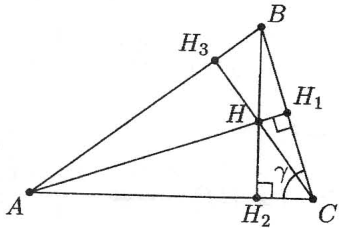
Let a=BCa = BC, b=ACb = AC, c=ABc = AB, and ∠A=α\angle A = \alpha, ∠B=β\angle B = \beta, ∠C=γ\angle C = \gamma. Let AH1AH_1, BH2BH_2, CH3CH_3 be altitudes, AL1AL_1, BL2BL_2, CL3CL_3 be angle bisectors, and AM1AM_1, BM2BM_2, CM3CM_3 be medians of △ABC\triangle ABC.
Then
AIL1I=b+ca,BIL2I=a+cb,CIL3I=a+bc. \frac{AI}{L_1I} = \frac{b+c}{a}, \quad \frac{BI}{L_2I} = \frac{a+c}{b}, \quad \frac{CI}{L_3I} = \frac{a+b}{c}.
Since AG:GM1=BG:GM2=CG:GM3=2:1AG : GM_1 = BG : GM_2 = CG : GM_3 = 2 : 1, we have
f(G)=AGM1G⋅BGM2G⋅CGM3G=2⋅2⋅2=8. f(G) = \frac{AG}{M_1G} \cdot \frac{BG}{M_2G} \cdot \frac{CG}{M_3G} = 2 \cdot 2 \cdot 2 = 8.
Hence,
f(I)=AIL1I⋅BIL2I⋅CIL3I=b+ca⋅a+cb⋅a+bc≥2bca⋅2acb⋅2abc=8=f(G), \begin{aligned} f(I) &= \frac{AI}{L_1I} \cdot \frac{BI}{L_2I} \cdot \frac{CI}{L_3I} = \frac{b+c}{a} \cdot \frac{a+c}{b} \cdot \frac{a+b}{c} \ge \frac{2\sqrt{bc}}{a} \cdot \frac{2\sqrt{ac}}{b} \cdot \frac{2\sqrt{ab}}{c} = 8 = f(G), \end{aligned}
i.e. f(I)≥f(G)f(I) \ge f(G) with the equality if and only if a=b=ca = b = c.

Further,
Figure 1

HH1=BH1⋅tg⁡∠HBH1==(ABcos⁡β)⋅tg⁡(90∘−γ)=c⋅cos⁡β⋅cos⁡γsin⁡γ \begin{aligned} HH_1 &= BH_1 \cdot \tg \angle HBH_1 = \\ &= (AB \cos \beta) \cdot \tg (90^\circ - \gamma) = \frac{c \cdot \cos \beta \cdot \cos \gamma}{\sin \gamma} \end{aligned}
and
AH=AH2cos⁡∠HAH2=AB⋅cos⁡αcos⁡(90∘−γ)=c⋅cos⁡αsin⁡γ. AH = \frac{AH_2}{\cos \angle HAH_2} = \frac{AB \cdot \cos \alpha}{\cos(90^\circ - \gamma)} = \frac{c \cdot \cos \alpha}{\sin \gamma}.
So we get AHH1H=cos⁡αcos⁡βcos⁡γ\frac{AH}{H_1H} = \frac{\cos \alpha}{\cos \beta \cos \gamma}. Similarly, BHH2H=cos⁡βcos⁡αcos⁡γ\frac{BH}{H_2H} = \frac{\cos \beta}{\cos \alpha \cos \gamma} and CHH3H=cos⁡γcos⁡αcos⁡β\frac{CH}{H_3H} = \frac{\cos \gamma}{\cos \alpha \cos \beta}.
Therefore, f(H)=AHH1H⋅BHH2H⋅CHH3H=1cos⁡αcos⁡βcos⁡γ. \text{Therefore, } f(H) = \frac{AH}{H_1H} \cdot \frac{BH}{H_2H} \cdot \frac{CH}{H_3H} = \frac{1}{\cos \alpha \cos \beta \cos \gamma}.
Let m=tg⁡α2m = \operatorname{tg}\frac{\alpha}{2}, n=tg⁡β2n = \operatorname{tg}\frac{\beta}{2} and k=tg⁡γ2k = \operatorname{tg}\frac{\gamma}{2}. By condition, α,β,γ∈(0∘,90∘)\alpha, \beta, \gamma \in (0^\circ, 90^\circ), so m,n,k∈(0,1)m, n, k \in (0, 1). Therefore,
f(H)=1cos⁡αcos⁡βcos⁡γ=1+m21−m2⋅1+n21−n2⋅1+k21−k2 f(H) = \frac{1}{\cos \alpha \cos \beta \cos \gamma} = \frac{1+m^2}{1-m^2} \cdot \frac{1+n^2}{1-n^2} \cdot \frac{1+k^2}{1-k^2}
We have
b+ca=ba+ca=sin⁡βsin⁡α+sin⁡γsin⁡α=2sin⁡β+γ2cos⁡β−γ2sin⁡(180∘−(β+γ))==2sin⁡β+γ2cos⁡β−γ2sin⁡(β+γ)=cos⁡β−γ2cos⁡β+γ2=cos⁡β2cos⁡γ2+sin⁡β2sin⁡γ2cos⁡β2cos⁡γ2−sin⁡β2sin⁡γ2==1+tg⁡β2tg⁡γ21−tg⁡β2tg⁡γ2=1+nk1−nk. \begin{aligned} \frac{b+c}{a} &= \frac{b}{a} + \frac{c}{a} = \frac{\sin \beta}{\sin \alpha} + \frac{\sin \gamma}{\sin \alpha} = \frac{2 \sin \frac{\beta+\gamma}{2} \cos \frac{\beta-\gamma}{2}}{\sin(180^\circ - (\beta+\gamma))} = \\ &= \frac{2 \sin \frac{\beta+\gamma}{2} \cos \frac{\beta-\gamma}{2}}{\sin(\beta+\gamma)} = \frac{\cos \frac{\beta-\gamma}{2}}{\cos \frac{\beta+\gamma}{2}} = \frac{\cos \frac{\beta}{2} \cos \frac{\gamma}{2} + \sin \frac{\beta}{2} \sin \frac{\gamma}{2}}{\cos \frac{\beta}{2} \cos \frac{\gamma}{2} - \sin \frac{\beta}{2} \sin \frac{\gamma}{2}} = \\ &= \frac{1 + \operatorname{tg} \frac{\beta}{2} \operatorname{tg} \frac{\gamma}{2}}{1 - \operatorname{tg} \frac{\beta}{2} \operatorname{tg} \frac{\gamma}{2}} = \frac{1 + nk}{1 - nk}. \end{aligned}
Similarly, a+cb=1+mk1−mk\frac{a+c}{b} = \frac{1+mk}{1-mk} and a+bc=1+mn1−mn\frac{a+b}{c} = \frac{1+mn}{1-mn}. So,
f(I)=a+bc⋅b+ca⋅c+ab=1+mn1−mn⋅1+nk1−nk⋅1+km1−km f(I) = \frac{a+b}{c} \cdot \frac{b+c}{a} \cdot \frac{c+a}{b} = \frac{1+mn}{1-mn} \cdot \frac{1+nk}{1-nk} \cdot \frac{1+km}{1-km}
Thus,
f(H)≥f(I)  ⟺  1+m21−m2⋅1+n21−n2⋅1+k21−k2≥1+mn1−mn⋅1+nk1−nk⋅1+km1−km f(H) \ge f(I) \iff \frac{1+m^2}{1-m^2} \cdot \frac{1+n^2}{1-n^2} \cdot \frac{1+k^2}{1-k^2} \ge \frac{1+mn}{1-mn} \cdot \frac{1+nk}{1-nk} \cdot \frac{1+km}{1-km}
Lemma. If x,y∈(0,1)x, y \in (0,1), then 1+x21−x2⋅1+y21−y2≥(1+xy1−xy)2\frac{1+x^2}{1-x^2} \cdot \frac{1+y^2}{1-y^2} \ge \left(\frac{1+xy}{1-xy}\right)^2 with the equality if and only if x=yx=y.
Proof. We have
1+x21−x2⋅1+y21−y2≥(1+xy1−xy)2  ⟺  (1+x2)(1+y2)(1−xy)2≥(1−x2)(1−y2)(1+xy)2  ⟺  (1+x2y2+x2+y2)(1+x2y2−2xy) \begin{aligned} \frac{1+x^2}{1-x^2} \cdot \frac{1+y^2}{1-y^2} &\ge \left(\frac{1+xy}{1-xy}\right)^2 \\ &\iff (1+x^2)(1+y^2)(1-xy)^2 \\ &\ge (1-x^2)(1-y^2)(1+xy)^2 \\ &\iff (1+x^2y^2+x^2+y^2)(1+x^2y^2-2xy) \end{aligned}
≥(1+x2y2−x2−y2)(1+x2y2+2xy). \geq (1 + x^2 y^2 - x^2 - y^2)(1 + x^2 y^2 + 2xy).
Let z=1+x2y2z = 1 + x^2 y^2, t=x2+y2t = x^2 + y^2, w=2xyw = 2xy, then
(z+t)(z−w)≥(z−t)(z+w)  ⟺  zt≥zw  ⟺  t≥w  ⟺  ⟺x2+y2≥2xy  ⟺  (x−y)2≥0, \begin{align*} (z+t)(z-w) &\ge (z-t)(z+w) \iff zt \ge zw \iff t \ge w \iff \\ &\Longleftrightarrow x^2+y^2 \ge 2xy \iff (x-y)^2 \ge 0, \end{align*}
which finishes the proof of the lemma.
By the lemma,
(1+m21−m2⋅1+n21−n2)(1+n21−n2⋅1+k21−k2)(1+k21−k2⋅1+m21−m2)≥≥(1+mn1−mn)2(1+nk1−nk)2(1+km1−km)2, \left(\frac{1+m^2}{1-m^2} \cdot \frac{1+n^2}{1-n^2}\right) \left(\frac{1+n^2}{1-n^2} \cdot \frac{1+k^2}{1-k^2}\right) \left(\frac{1+k^2}{1-k^2} \cdot \frac{1+m^2}{1-m^2}\right) \ge \\ \ge \left(\frac{1+mn}{1-mn}\right)^2 \left(\frac{1+nk}{1-nk}\right)^2 \left(\frac{1+km}{1-km}\right)^2,
i.e.
(1+m21−m2⋅1+n21−n2⋅1+k21−k2)2≥(1+mn1−mn⋅1+nk1−nk⋅1+km1−km)2, \left( \frac{1+m^2}{1-m^2} \cdot \frac{1+n^2}{1-n^2} \cdot \frac{1+k^2}{1-k^2} \right)^2 \ge \left( \frac{1+mn}{1-mn} \cdot \frac{1+nk}{1-nk} \cdot \frac{1+km}{1-km} \right)^2,
with equality if and only if m=n=km = n = k, which gives the required statement of the problem.

Want a route through all this instead of an archive? The track puts 2,604 problems in a working order, from Junior Challenge level to the IMO shortlist.

Source: MathNet, licensed CC-BY-4.0. Statement reproduced verbatim; metadata (topic, difficulty) added by this project.