Maths Olympiad Prep

Library / /1 of 6

Geometry Difficulty 5.1 AIME, harder Prove it Ukraine

There is an equilateral trapezoid with bases BCBC and ADAD and known angles: BDC=10\angle BDC = 10^\circ and BDA=70\angle BDA = 70^\circ. Prove that the following equality holds true: AD2=BC(AD+AB)AD^2 = BC(AD + AB).

Solution

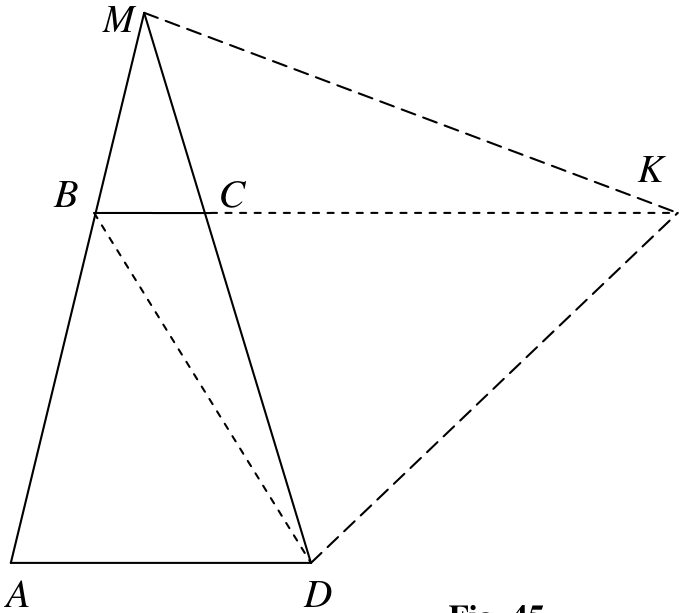
It is clear that AMD=20\angle AMD = 20^\circ, DBM=150\angle DBM = 150^\circ. Let's construct equilateral triangle KMD\triangle KMD, then points MM, BB, DD are on the circle centered at KK (fig. 8.76). After that KM=KBKM = KB, KMB=80\angle KMB = 80^\circ, from where MBK=80\angle MBK = 80^\circ, but where MBC=80\angle MBC = 80^\circ as well, which implies that points BB, CC, KK are on the same line.

Then AMD=BKM\triangle AMD = \triangle BKM, as isosceles with equal sides and angles at the base. Therefore MB=ADMB = AD. From similarity of MBCMAD\triangle MBC \sim \triangle MAD we have that BCAD=MBMA\frac{BC}{AD} = \frac{MB}{MA} \Rightarrow ADBM=BCMAAD \cdot BM = BC \cdot MA, hence we obtain that

Figure 1
Fig. 45

AD2=BC(MB+AB)=BC(AD+AB). AD^2 = BC(MB + AB) = BC(AD + AB).

Want a route through all this instead of an archive? The track puts 2,000 problems in a working order, from AMC 10 level to the IMO shortlist.

Source: MathNet, licensed CC-BY-4.0. Statement and solution reproduced as published; topic and difficulty added by this site.