The convex quadrilateral is given.
, , , is the intersection point of its diagonals.
Prove, that .
Ukrainian Mathematical Competitions
Solution
Let's draw a circle with the center at the point and radius . Points and are located on this circle, but , so, arc , that doesn't contain point , is . That's why its inscribed angle is . So, point is located on the circle too. Then it's easy to calculate angles (Fig. 47).
, -- is subtended by the central angle , because is isosceles and the apex angle is . So,
. So, that's why is also isosceles and similar to , that's why we can write the following equation:
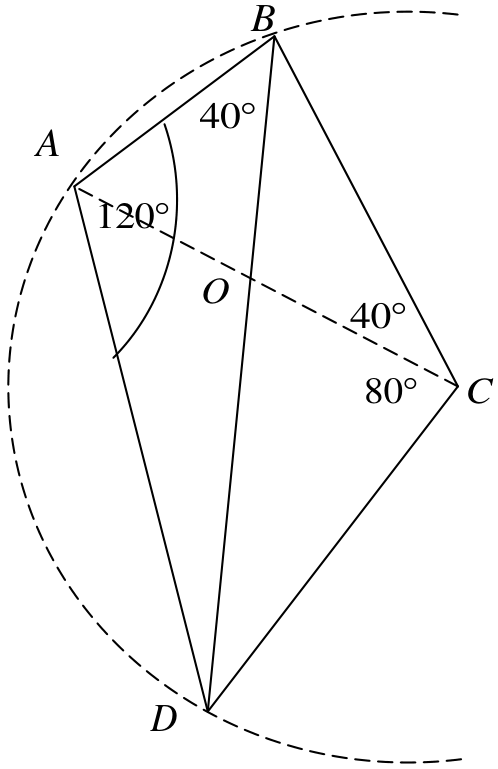
Fig. 47
What had to be demonstrated.
Want a route through all this instead of an archive? The track
puts 2,604 problems in a working order, from Junior Challenge level to the IMO shortlist.