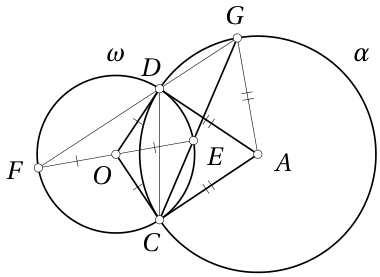
Circle with center and circle with center intersect at two distinct points and , whereas . A point is chosen on circle inside circle . Let be the reflection of point over the point , and the intersection of line with circle (). Prove that points , , and are collinear.
Estonian Mathematical Olympiad
Solution
The line perpendicular to the radius of the circle is tangent to this circle. Hence we get . From the equality of inscribed angles, we get . Since , we finally get . In conclusion,
Therefore, points , , and are collinear.
Solution 2:
We express the value of angle as the sum of the values of angles , , and (Fig. 35). Let .
Firstly, note that . Using this and the relationship between central and inscribed angles in circle , we get
By symmetry, .
Next, note that . Using this and the equality of inscribed angles,
Therefore, points , , and are collinear.
Solution 3:
We express the value of angle as the sum of the values of angles , , and (Fig. 36). Let .
Firstly, note that . Using this and the relationship between central and inscribed angles in circle , we get
By symmetry, . The line , which is perpendicular to the radius of the circle , is tangent to circle . Therefore, . Since is a diameter of circle , . In conclusion, . Therefore, points , , and are collinear.
Want a route through all this instead of an archive? The track
puts 2,604 problems in a working order, from Junior Challenge level to the IMO shortlist.