In an acute triangle with , points , and are the feet of the altitudes drawn from vertices , and , respectively. Let the orthocenter of be and the midpoint of the side be . Point on the prolongation of the line segment beyond and point on the line segment satisfy . Prove that points , and lie on a line.
Estonian Mathematical Olympiad
Solutions — 3
Solution 1
Firstly, we prove that is an isosceles trapezium (Fig. 44). As , points , , and lie on a circle with diameter . Hence is the center of this circle. Consequently, , implying
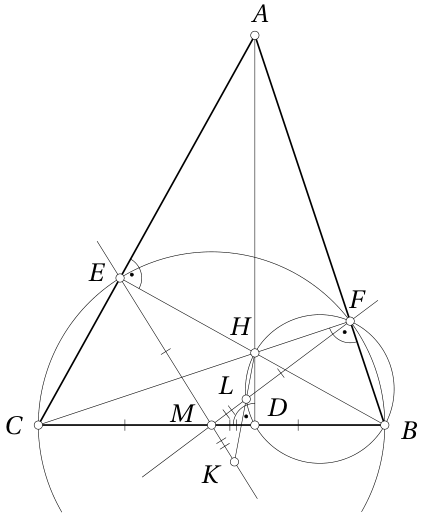
Fig. 44
. Hence and the desired claim follows.
Consequently, points , , and also lie on a circle (Fig. 45). Since , we know that is a diameter of this circle. Thus lies on this circle, too. Now
But implies that points , , and lie on a line.
Solution 2
As in Solution 1, we prove that is an isosceles trapezium whose circumcircle passes through . By interchanging the roles of and , the roles of and , and the roles of and , we analogously obtain that is an isosceles trapezium whose circumcircle passes through (Fig. 46). Now , but, on the other hand,
As , the quadrilateral is cyclic, implying that . Consequently, , implying that points , and lie on a line.
Solution 3
As in Solution 1, we prove that points , , , and lie on a circle with diameter . By interchanging the roles of and , the roles of and , and the roles of and , we analogously obtain that points , , , and lie on a circle with diameter . As and by Thales' theorem (Fig. 47), it suffices to prove that . To this end, note that
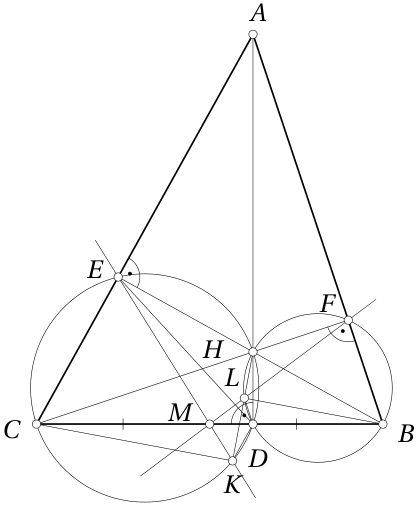
Fig. 46
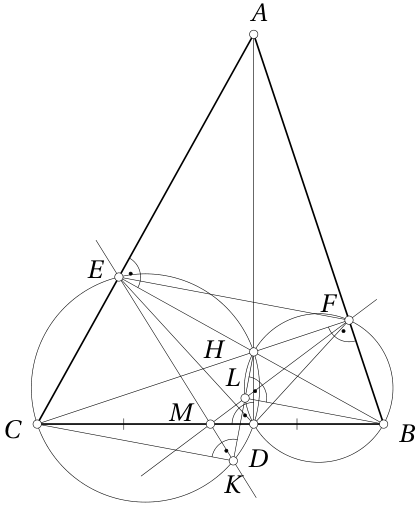
Fig. 47
It is known that the midpoints of sides of a triangle and the feet of altitudes of the triangle lie on a circle (so-called nine-point circle). Hence , , and are concyclic, implying that . Consequently, , proving the desired result.
Want a route through all this instead of an archive? The track
puts 2,604 problems in a working order, from Junior Challenge level to the IMO shortlist.