f is a map on the plane such that two points a distance 1 apart are always taken to two points a distance 1 apart. Show that for any d, f takes two points a distance d apart to two points a distance d apart.
Solution
Observe first that the images of equilateral triangles of side 1 are equilateral triangles of side 1. Consider two equilateral triangles ABC and A′B′C with side 1 and a common side. Notice that AA′=3 and f(A)f(A′)=0 or 3. If f(A)=f(A′), then consider B such that AB=1 and A′B=3, so f(A)f(B)=1⇔f(A′)f(B)=1, contradiction. So f(A)f(A′)=3 and all points 3 apart are taken to two points 3 apart.
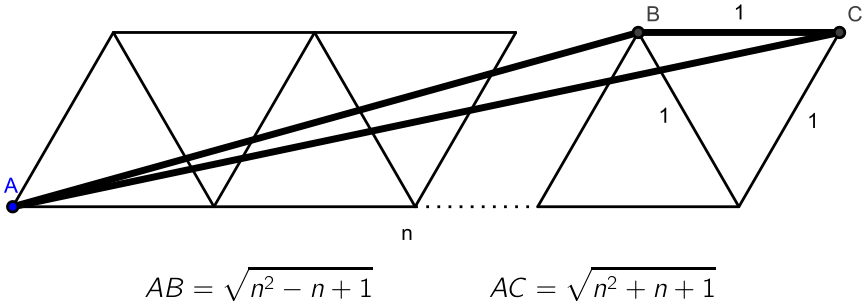
So any triangular lattice is taken to a triangular lattice. In particular, any triangle with sides 1, n2−n+1 and n2+n+1 are preserved by f.
Consider two different triangles ABC and AB′C such that B′C=BC=1, AB=AB′=n2−n+1 and AC=n2+n+1. Notice that BB′=n2+n+13. Let ϵn=n2+n+13. Again, f(B)f(B′)=0 or ϵn. If B=A0 and B′=A1 and f(B)=f(B′), let k be an integer such that kϵn<1≤(k+1)ϵn and A2,A3,…,Ak+1 points such that AiAi+1=ϵn, i=0,1,2,…,k, and A0Ak+1=1. We have f(A0)f(Ak+1)=1, so by the triangle inequality,
which is a contradiction. So f(A0)f(A1)=ϵn for all points A0,A1, ϵn apart. Moreover, if AB=mϵn, m positive integer, f(A)f(B)=mϵn.
Now let X and Y be two arbitrary points and suppose that f(X)f(Y)=XY. Choose n such that ∣XY−f(X)f(Y)∣>4ϵn and P such that PX=mϵn, m integer, and PY=2ϵn. Then f(X)f(P)=XP=mϵn, f(Y)f(P)=2ϵn and ∣f(X)f(Y)−XY∣≤∣f(X)f(Y)−f(P)f(X)∣+∣f(P)f(X)−XY∣=
Want a route through all this instead of an archive? The track
puts 2,604 problems in a working order, from Junior Challenge level to the IMO shortlist.
Source: MathNet,
licensed CC-BY-4.0.
Statement reproduced verbatim; metadata (topic, difficulty) added by this project.