Maths Olympiad Prep

Library / /69 of 82

Geometry Difficulty 6.3 National olympiad Prove it Croatia

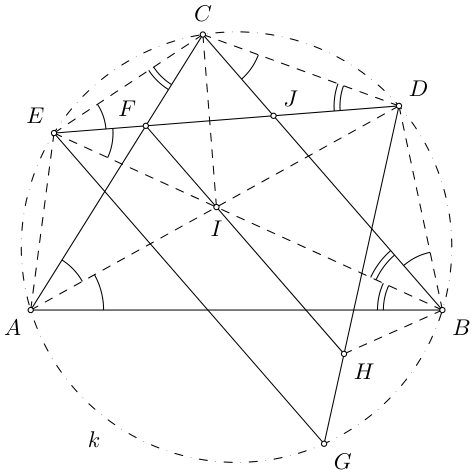
Let II be the incentre of the acute triangle ABCABC. Rays AIAI and BIBI intersect the circumcircle kk of the triangle ABCABC in points DD and EE respectively. Segments DEDE and CACA intersect in point FF, line through point EE parallel to the line FIFI intersects circle kk also in point GG, and lines FIFI and DGDG intersect in point HH. Prove that the lines CACA and BHBH touch the circumcircle of the triangle DFHDFH at points FF and HH respectively.

Solution

Let us denote BAC=α\angle BAC = \alpha, CBA=β\angle CBA = \beta, ACB=γ\angle ACB = \gamma, and let JJ be the intersection of the segments DE\overline{DE} and CB\overline{CB}.
Figure 1
Inscribed angles BED\angle BED, BCD\angle BCD and BAD\angle BAD over the chord BDBD are equal, so BED=BCD=BAD=α2\angle BED = \angle BCD = \angle BAD = \frac{\alpha}{2}. Analogously, DEC=DBC=DAC=α2\angle DEC = \angle DBC = \angle DAC = \frac{\alpha}{2}, ECA=EBA=β2\angle ECA = \angle EBA = \frac{\beta}{2} and CDE=CBE=β2\angle CDE = \angle CBE = \frac{\beta}{2}.
Since DFC=DEC+ECA=α2+β2\angle DFC = \angle DEC + \angle ECA = \frac{\alpha}{2} + \frac{\beta}{2} and CJE=CDE+BCD=β2+α2\angle CJE = \angle CDE + \angle BCD = \frac{\beta}{2} + \frac{\alpha}{2}, the triangle CFJCFJ is isosceles.
On the other hand, lines FHFH and EGEG are parallel, thus DHF=DGE=180ECD=180(ECA+ACB+BCD)=180(β2+γ+α2)=α2+β2=\angle DHF = \angle DGE = 180^\circ - \angle ECD = 180^\circ - (\angle ECA + \angle ACB + \angle BCD) = 180^\circ - (\frac{\beta}{2} + \gamma + \frac{\alpha}{2}) = \frac{\alpha}{2} + \frac{\beta}{2} =

<DFC<DFC and, by the converse of the tangent chord theorem, we conclude that the line CACA touches the circumcircle of the triangle DFHDFH at point FF.
Since line CICI is the angle bisector of <FCJ<FCJ, we have CIDECI \perp DE. Since <BED<BED = <DEC<DEC, line DEDE is the bisector of the segment CI\overline{CI} and <IFD<IFD = <DFC<DFC = α2+β2\frac{\alpha}{2} + \frac{\beta}{2}. This implies that <HFD<HFD = <DFC<DFC = <CJE<CJE = <BJD<BJD. We conclude that the lines FHFH and BCBC are parallel. From <FHD<FHD = <GED<GED = α+β2\frac{\alpha+\beta}{2} = <HFD<HFD we conclude that the triangle DFHDFH is isosceles.
Since DD is the midpoint of the arc \overarcBC\overarc{BC} and triangles DCBDCB and DFHDFH are isosceles with BCBC parallel to FHFH, the line BHBH is symmetric to the line CFCF with respect to the bisector of the segment FH\overline{FH}. Hence, the line BHBH also touches the circumcircle of the triangle DFHDFH, at point HH.

Want a route through all this instead of an archive? The track puts 2,000 problems in a working order, from AMC 10 level to the IMO shortlist.

Source: MathNet, licensed CC-BY-4.0. Statement and solution reproduced as published; topic and difficulty added by this site.