Let be the incenter of triangle . is a point on arc of the circumcircle of triangle such that if and are the feet of the perpendiculars from to and , respectively, and is the midpoint of , then . If is the foot of the perpendicular from to , show that .
Iranian Mathematical Olympiad
Solution
First, we prove two lemmas.
Lemma 1. Let and be two lines and , and three points in the plane. Denote by and the perpendicular projections of on and , respectively. Furthermore, let be the midpoint of . and are defined similarly. , and are collinear if and only if , and are collinear.
Proof. The key observation is that and . Using these observations and the Thales' theorem, it is easy to check that the assertion is equivalent to the equality .
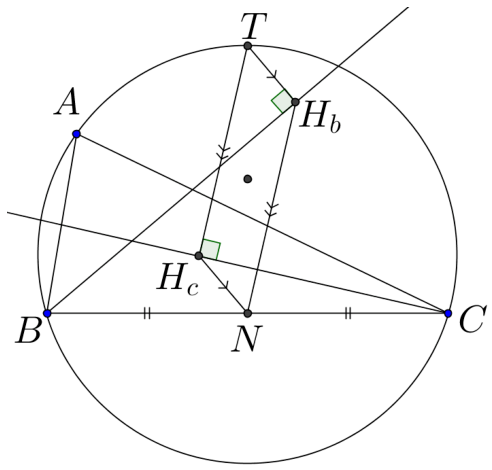
Lemma 2. Let be the midpoint of arc of the circumcircle of triangle . Furthermore, let and be the feet of the perpendicular lines from to the internal bisectors of and , respectively. If is the midpoint of , then lies on the perpendicular bisector of side .
Proof. Let be the midpoint of side . Note that and , hence the quadrilateral is cyclic and
It means that is parallel to the external bisector of . On the other hand, is also parallel to the external bisector of and thus . Similarly, . So is a parallelogram and hence , the midpoint of , lies on . But is the perpendicular bisector of side , which is what we desired to prove.
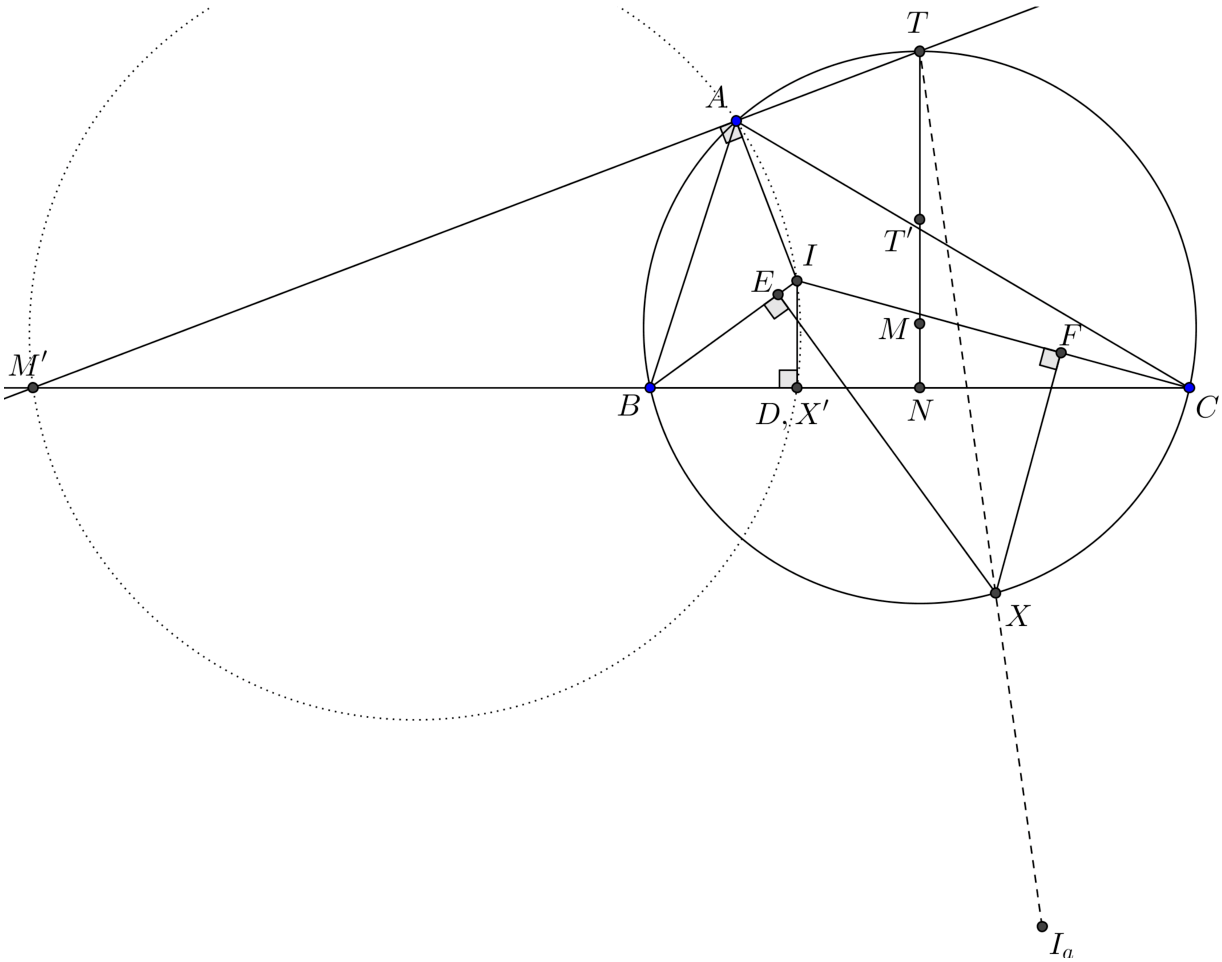
We will keep using the notations in lemma 2. We will now apply lemma 1, with , , , and playing the roles of , , , and , respectively. Since , and are collinear, we obtain that , and are collinear, too. Now, by an inversion with center and power and then a reflection with respect to the internal bisector of angle , is sent to , is sent to , is sent to and is sent to the foot of the external bisector of , say . If is the image of under this transformation, then points , , and are on a common circle. So . On the other hand, since the line is the image of the circumcircle of triangle under this transformation, lies on the line . This implies that and thus .
Want a route through all this instead of an archive? The track
puts 2,604 problems in a working order, from Junior Challenge level to the IMO shortlist.