The sides of an equilateral triangle measure cm. Denote the orthogonal projections of the midpoint of the side onto the sides and by and . Find the area of the triangle .
Slovenian Mathematical Olympiad, 2008
Solutions — 3
Solution 1
We have . The angles of the triangle measure , and , so is one half of an equilateral triangle. This implies . A similar argument for the triangle shows that this triangle is congruent to the triangle . The lengths of the sides and are , so the area of each of the two triangles is .
In the triangle the lengths of the sides are and , so this is an isosceles triangle with the angle of at the apex. The triangle is therefore equilateral. Its area is .
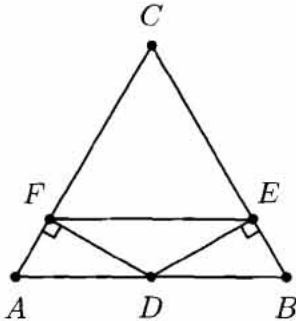
By subtracting the areas of triangles , and from the area of the triangle we can obtain the area of the triangle :
Solution 2
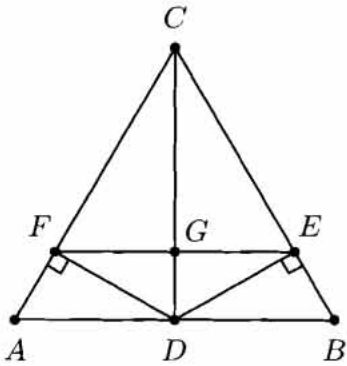
We see that . The angles of triangles and are equal to , and and these two triangles agree in the lengths of the hypotenuses, so they are congruent. This implies , so is an isosceles triangle. Let be the intersection of segments and . Since , is the altitude in the triangle . Triangles and are congruent and their angles are , and .
Triangles , and are similar. From the first two we get , so . Similarly, , implies .
Since and are similar, we have , so . Likewise, implies .
The area of the triangle is equal to the sum of the areas of triangles and , so
Solution 3
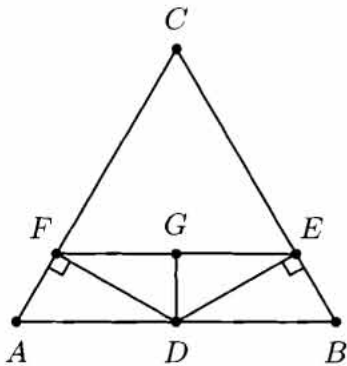
Obviously, . Triangles and are congruent since they both have angles equal to , and and the lengths of the two hypotenuses are also equal. So, . Let be the midpoint of the segment . Since is parallel to , right triangles and are congruent and . Thus,
Want a route through all this instead of an archive? The track
puts 2,604 problems in a working order, from Junior Challenge level to the IMO shortlist.