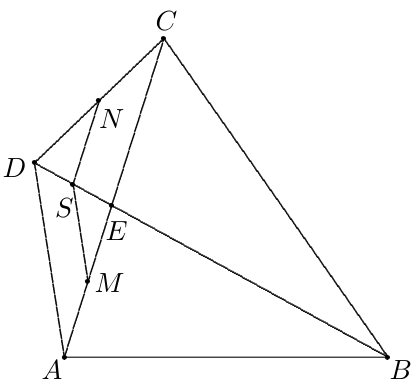
The diagonals and of a convex quadrilateral intersect at point , is the midpoint of and is the midpoint of . It is known that the diagonal bisects . Prove that the quadrilateral is cyclic if and only if the quadrilateral is cyclic.
Fall Mathematical Competition
Solution
Let be a cyclic quadrilateral. Since it follows that . Denote by the midpoint of . Then and . Hence is an isosceles trapezoid and therefore it is cyclic. On the other hand, we have and we conclude that the quadrilateral is inscribed. Thus the points and are concyclic, i.e. the quadrilateral is cyclic.
Conversely, let be a cyclic quadrilateral. Let us denote by the intersection point of the line and the circumcircle of . We shall prove that . Let lie between and (the case, when is between and , is analogous). If is the midpoint of , we see as above that the quadrilateral is cyclic. Hence the points and are concyclic. However, this is impossible when since then lies on the midsegment of through , which means that is inside .
Want a route through all this instead of an archive? The track
puts 2,604 problems in a working order, from Junior Challenge level to the IMO shortlist.