We prove that the midpoint M of AB satisfies the given condition.
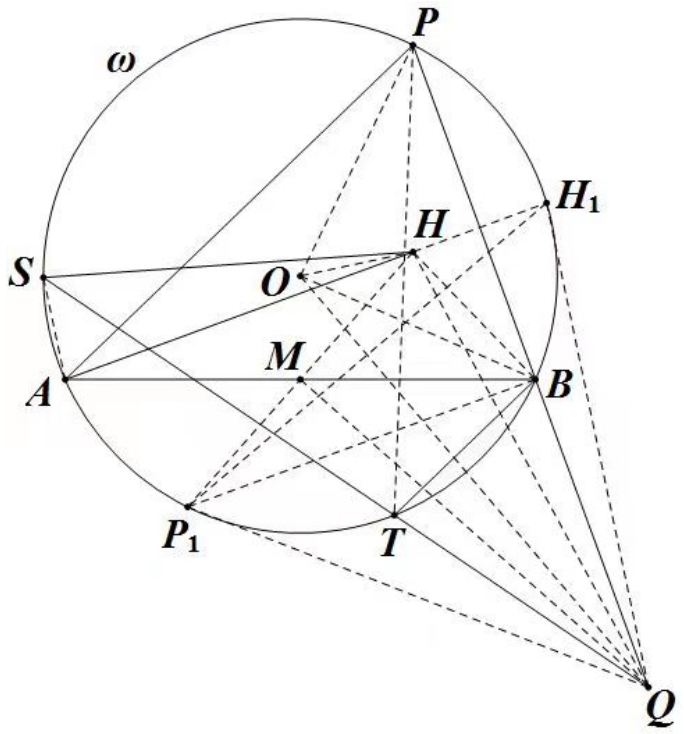
Let P1 be the antipodal point of P on the circle ω, and let H1 be the intersection of the extension of AH with ω. We will show that QP1=QH1.
Denote O as the center of ω. Since SH=AH, we have that S and A are symmetric with respect to OH, implying OH⊥SA. Also, HB⊥AP, so ∠BHO−180∘−∠SAP=180∘−∠STP=∠PTQ. By noting that TB∥AP, we have ∠TPQ=∠APB−∠APT=∠APB−∠PAB=∠HBO. Thus, △PTQ∼△BHO, which gives PTPQ=BHBO. Since PT=AB and BO=PO, we obtain ABPQ=BHPO. Furthermore, ∠OPQ=90∘−∠PAB=∠ABH, implying △OPQ∼△HBA. Therefore, ∠OQP=∠HAB=∠H1AB=∠H1P1B. Since PQ⊥P1B, it follows that OQ⊥P1H1, and thus OQ bisects P1H1 perpendicularly, leading to QP1=QH1.
Since H1 and H are symmetric with respect to BP, we have QH=QH1=QP1. Also, it is well-known that M is the midpoint of HP1, so QM⊥MH. Consequently, the circle with diameter HQ passes through the midpoint M of AB. □