Let O and L be the circumcenters of the triangles ABC and KMC, respectively, H the orthocenter of the triangle ABC. Let S and P be the midpoints of the segments KM and CH, respectively. Let R denote the circumradius of the triangle ABC. Since A, B, A1, B1 lie on the circle with AB as its diameter, we have ∠CB1A1=180∘−∠AB1A1=∠ABC, so △A1B1C∼△ABC and the ratio of similitude is equal to k=CB1/CB=cos∠ACB. Since CH is the diameter of circumcircle of the triangle CB1A1 (∠CB1H=90∘), we have CH=2Rcos∠ACB. Since △AOB is isosceles and ∠AOB=2∠ACB, we have
OM=AOcos∠AOM=Rcos∠ACB=CH/2=CP=PH.
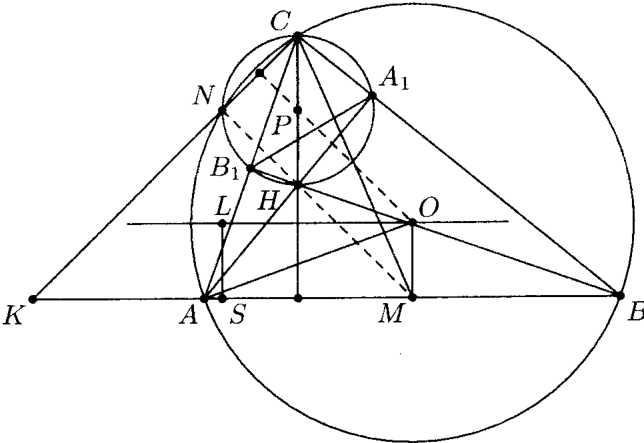
Taking into account that PH⊥AB and OM⊥AB, we obtain PH∥OM, so PHMO is a parallelogram. Since PO is the line of centers of circumcircles of the triangles CB1A1 and ABC, we have PO⊥CN. Then MH⊥CN. Since the angle CNH subtends the diameter of the circumcircle of the triangle CB1A1, we have NH⊥CN, so N, H, M lie on the same line. Moreover, MN is the altitude of △KMC, so H is the orthocenter of △KMC (CH⊥AB). Therefore LS=CH/2=PH=OM, hence the lines LO and KB are parallel, as required.