Let and be odd integers. Distinct real numbers are written in the cells of a table of rows and columns. A number is called good if:
1. it is the largest in its row (column);
2. it is the middle number of its column (row).
What is the maximal number of good numbers?
Spring Mathematical Tournament
Solution
Let be the set of good numbers that are largest in their column and middle in their row. Since no two of these numbers belong to one and the same row we have . Denote by the largest element of and let be the numbers in the row of that are greater than . It is clear that there are no elements from in the columns of . Since there is at most one element of in every column it follows that . Thus,
Analogously we obtain that the number of good numbers that are largest in their rows is at most . We shall show that for every odd and there exists a table such that the number of good numbers equals .
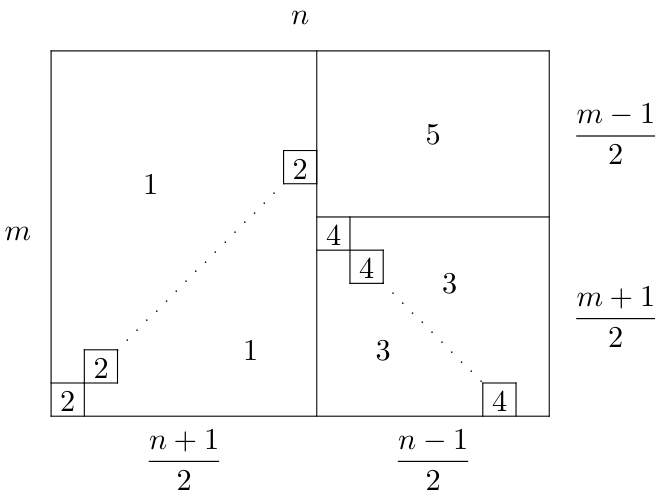
1. If without loss of generality assume that . Mark the cells of the table by the digits 1, 2, 3, 4 and 5 as shown on the figure. Next, fill in the cells by writing consecutively the numbers 1, 2, 3, ..., , starting with the cells marked by 1, then by 2 and so on. All numbers written in the cells marked by 2 or 4 are good. Their number equals:
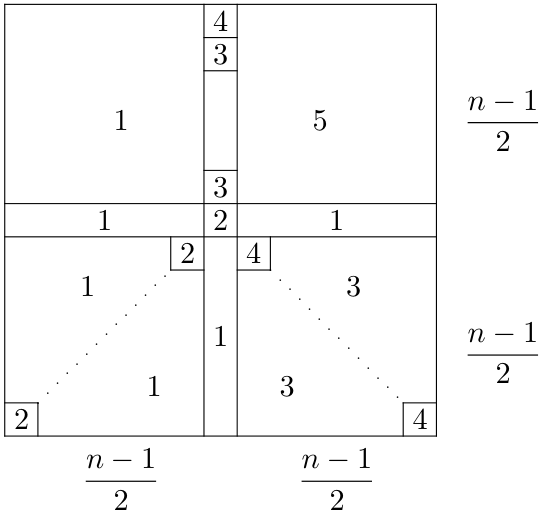
2. Let and . As in 1. we fill the following table. The good numbers are again in cells marked by 2 or 4. Their number equals:
3. If , then the table (5,6,7 and 8 are good) shows that the number of good numbers is 4 and .
<table>
<tr><td>1</td><td>7</td><td>9</td></tr>
<tr><td>2</td><td>6</td><td>4</td></tr>
<tr><td>5</td><td>3</td><td>8</td></tr>
</table>
Want a route through all this instead of an archive? The track
puts 2,604 problems in a working order, from Junior Challenge level to the IMO shortlist.