If AΓE=ω, from the right angled triangle ΓΘB we have:
ΓB^Θ=90∘−BΓ^Θ=90∘−ω,(1)
since BΓΘ=AΓE=ω, and moreover BE^K=90∘, and so
ΓB^Θ+BH^K=90∘−ω+90∘=180∘−ω<180∘,
Which gives that the lines BΘ and ΔH intersect at a point, say K. Therefore, it is enough to prove that the points Z, E and K are collinear.
The quadrilateral EΔΓZ is isosceles trapezium, because EΔ∥ZΓ and ZE=AE=ΓΔ. Indeed, the triangles AEZ and AΓE have the angle A in common and AE^Z=AΓE=ω, therefore they have equal angles. Therefore the triangle AZE is isosceles with AE^Z=EA^Z. It follows that: AE=ZE.
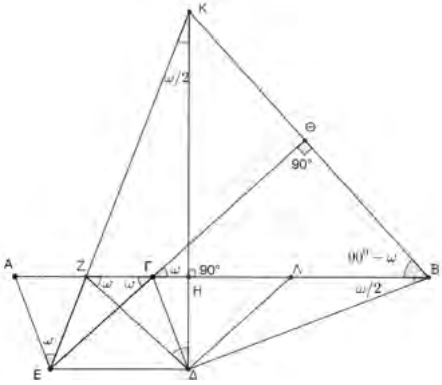
figure 2
From the isosceles trapezium EΔΓZ we have that:
EZ^Γ=ZΓ^Δ=180∘−ΓA^E=180∘−(2180∘−ω)=90∘+2ω.(2)
From the orthogonal triangle ΔHZ we have
ZΔ^H=90∘−ΔZ^H=90∘−ω.(3)
From (1) and (3) it follows that the quadrilateral BΔZK is cyclic.
If Λ is the midpoint of the segment ΓB we observe that the quadrilateral EΔΛΓ has EΔ∥ΓΛ, ΓE=ΔE=AΓ=ΓΛ, since AΓ=31AB and Λ is the midpoint of ΓB. Hence EΔΛΓ is rhombus. Hence, we have ΛΓΔ=ω and moreover ΔΛ=ΛΓ=ΛB=2ΓB. It means that the triangle ΓΔB is orthogonal at Δ and from the isosceles triangle ΛΔB we have : ΔB^Λ=2ω.
From the cyclic quadrilateral BΔZK we have:
ZK^Δ=ΔB^Z=ΔB^Λ=2ω,(4)
οπότε από το ορθογώνιο τρίγωνο HZK και τη σχέση (4) έπεται ότι:
ΓZ^K=HZ^K=90∘−2ω(5)
From (2) and (5) it follows that:
EZ^Γ+ΓZ^K=90∘+2ω+90∘−2ω=180∘,
and hence the points A, E and K are collinear.