Maths Olympiad Prep

Library / International Mathematical Olympiad /91 of 110

International Mathematical Olympiad

Geometry Difficulty 8.8 Shortlist Prove it IMO

Let AA′BCC′B′A A^{\prime} B C C^{\prime} B^{\prime} be a convex cyclic hexagon such that ACA C is tangent to the incircle of the triangle A′B′C′A^{\prime} B^{\prime} C^{\prime}, and A′C′A^{\prime} C^{\prime} is tangent to the incircle of the triangle ABCA B C. Let the lines ABA B and A′B′A^{\prime} B^{\prime} meet at XX and let the lines BCB C and B′C′B^{\prime} C^{\prime} meet at YY.
Prove that if XBYB′X B Y B^{\prime} is a convex quadrilateral, then it has an incircle.

Solution

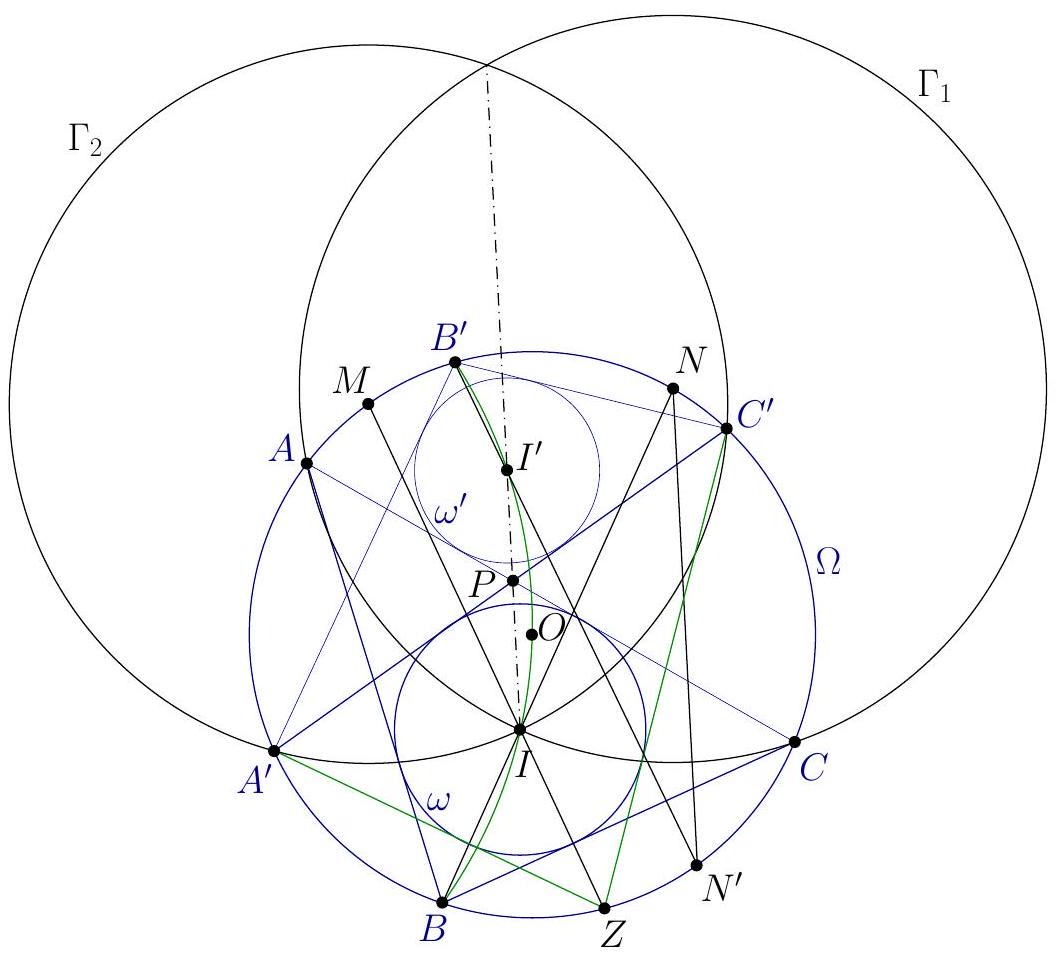
Denote by ω\omega and ω′\omega^{\prime} the incircles of △ABC\triangle A B C and △A′B′C′\triangle A^{\prime} B^{\prime} C^{\prime} and let II and I′I^{\prime} be the centres of these circles. Let NN and N′N^{\prime} be the second intersections of BIB I and B′I′B^{\prime} I^{\prime} with Ω\Omega, the circumcircle of A′BCC′B′AA^{\prime} B C C^{\prime} B^{\prime} A, and let OO be the centre of Ω\Omega. Note that ON⊥ACO N \perp A C, ON′⊥A′C′O N^{\prime} \perp A^{\prime} C^{\prime} and ON=ON′O N=O N^{\prime} so NN′N N^{\prime} is parallel to the angle bisector II′I I^{\prime} of ACA C and A′C′A^{\prime} C^{\prime}. Thus II′∥NN′I I^{\prime} \| N N^{\prime} which is antiparallel to BB′B B^{\prime} with respect to BIB I and B′I′B^{\prime} I^{\prime}. Therefore B,I,I′,B′B, I, I^{\prime}, B^{\prime} are concyclic.
Figure 1

Further define PP as the intersection of ACA C and A′C′A^{\prime} C^{\prime} and MM as the antipode of N′N^{\prime} in Ω\Omega. Consider the circle Γ1\Gamma_{1} with centre NN and radius NA=NCN A=N C and the circle Γ2\Gamma_{2} with centre MM and radius MA′=MC′M A^{\prime}=M C^{\prime}. Their radical axis passes through PP and is perpendicular to MN⊥NN′∥IPM N \perp N N^{\prime} \| I P, so II lies on their radical axis. Therefore, since II lies on Γ1\Gamma_{1}, it must also lie on Γ2\Gamma_{2}. Thus, if we define ZZ as the second intersection of MIM I with Ω\Omega, we have that II is the incentre of triangle ZA′C′Z A^{\prime} C^{\prime}. (Note that the point ZZ can also be constructed directly via Poncelet's porism.)

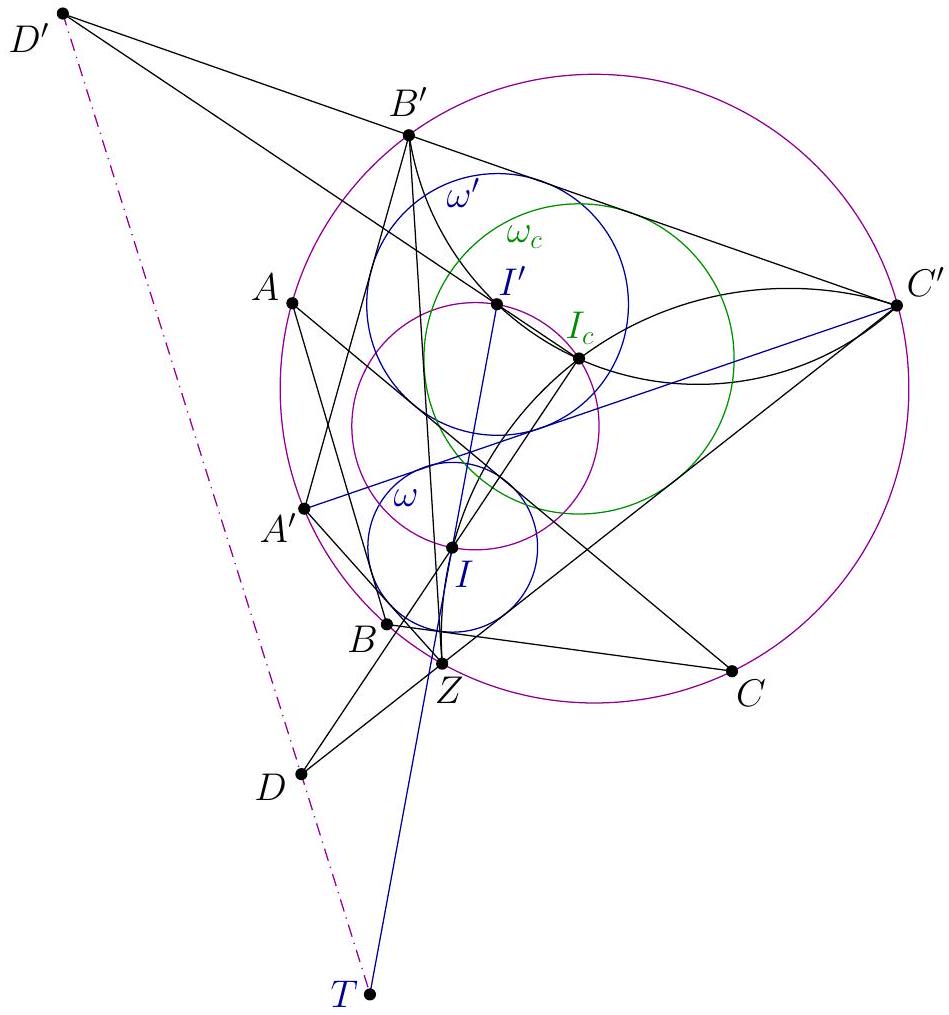
Consider the incircle ωc\omega_{c} with centre IcI_{c} of triangle C′B′ZC^{\prime} B^{\prime} Z. Note that ∠ZIC′=90∘+12∠ZA′C′=90∘+12∠ZB′C′=∠ZIcC′\angle Z I C^{\prime}=90^{\circ}+ \frac{1}{2} \angle Z A^{\prime} C^{\prime}=90^{\circ}+\frac{1}{2} \angle Z B^{\prime} C^{\prime}=\angle Z I_{c} C^{\prime}, so Z,I,Ic,C′Z, I, I_{c}, C^{\prime} are concyclic. Similarly B′,I′,Ic,C′B^{\prime}, I^{\prime}, I_{c}, C^{\prime} are concyclic.

The external centre of dilation from ω\omega to ωc\omega_{c} is the intersection of IcI_{c} and C′ZC^{\prime} Z ( DD in the picture), that is the radical centre of circles Ω,C′IcIZ\Omega, C^{\prime} I_{c} I Z and II′IcI I^{\prime} I_{c}. Similarly, the external centre of dilation from ω′\omega^{\prime} to ωc\omega_{c} is the intersection of I′IcI^{\prime} I_{c} and B′C′B^{\prime} C^{\prime} ( D′D^{\prime} in the picture), that is the radical centre of circles Ω,B′I′IcC′\Omega, B^{\prime} I^{\prime} I_{c} C^{\prime} and II′IcI I^{\prime} I_{c}. Therefore the Monge line of ω,ω′\omega, \omega^{\prime} and ωc\omega_{c} is line DD′D D^{\prime}, and the radical axis of Ω\Omega and circle II′IcI I^{\prime} I_{c} coincide. Hence the external centre TT of dilation from ω\omega to ω′\omega^{\prime} is also on the radical axis of Ω\Omega and circle II′IcI I^{\prime} I_{c}.
Figure 2

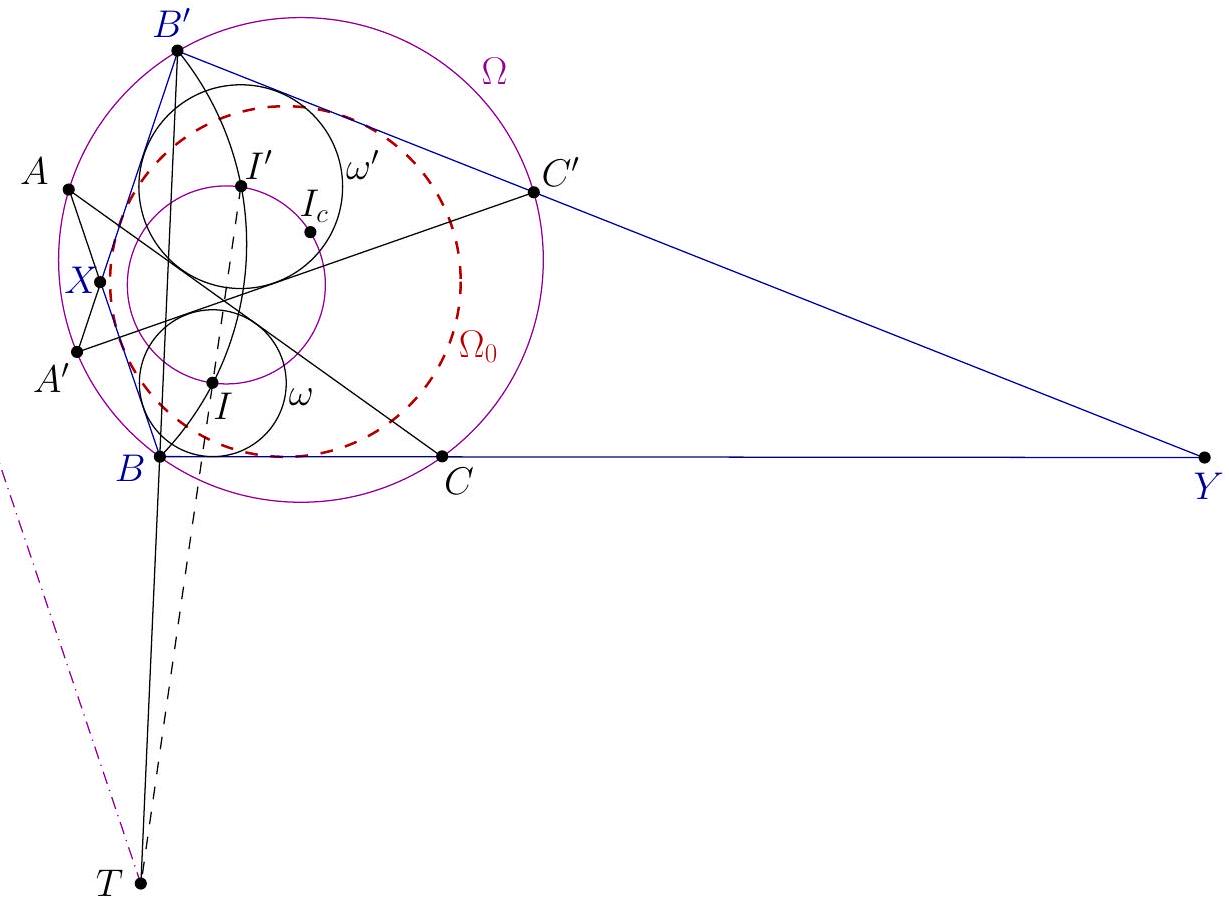
Now since B,I,I′,B′B, I, I^{\prime}, B^{\prime} are concyclic, the intersection T′T^{\prime} of BB′B B^{\prime} and II′I I^{\prime} is on the radical axis of Ω\Omega and circle II′IcI I^{\prime} I_{c}. Thus T′=TT^{\prime}=T and TT lies on line BB′B B^{\prime}. Finally, construct a circle Ω0\Omega_{0} tangent to A′B′,B′C′,ABA^{\prime} B^{\prime}, B^{\prime} C^{\prime}, A B on the same side of these lines as ω′\omega^{\prime}. The centre of dilation from ω′\omega^{\prime} to Ω0\Omega_{0} is B′B^{\prime}, so by Monge's theorem the external centre of dilation from Ω0\Omega_{0} to ω\omega must be on the line TBB′T B B^{\prime}. However, it is on line ABA B, so it must be BB and BCB C must be tangent to Ω0\Omega_{0} as desired.
Figure 3

Want a route through all this instead of an archive? The track puts 2,604 problems in a working order, from Junior Challenge level to the IMO shortlist.

Source: MathNet, licensed CC-BY-4.0. Statement reproduced verbatim; metadata (topic, difficulty) added by this project.