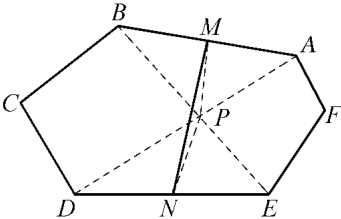
A convex hexagon is given in which any two opposite sides have the following property: the distance between their midpoints is 23 times the sum of their lengths. Prove that all the angles of the hexagon are equal. (A convex hexagon ABCDEF has three pairs of opposite sides: AB and DE, BC and EF, CD and FA.)
Solution
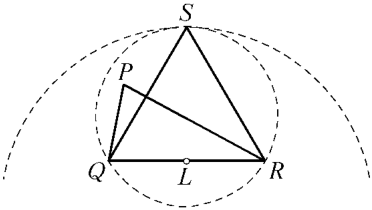
Proof I We first prove the following lemma. Lemma Consider a triangle PQR with ∠QPR≥60∘. Let L be the midpoint of QR. Then PL≤23QR. The equality holds if and only if the triangle PQR is equilateral. Proof of the lemma Let S be the point such that the triangle QRS is equilateral, where the points P and S lie in the same half-plane bounded by the line QR. Then the point P lies inside the circumcircle (including the circumference of the circle) of the triangle QRS, which lies inside the circle with center L and radius 23QR. This completes the proof of the lemma. The main diagonals of a convex hexagon form a triangle though the Thus we may choose two of these three diagonals that form an angle greater than or equal to 60∘. Without loss of generality, we may assume that the diagonals AD and BE of the given hexagon ABCDEF satisfy ∠APB≥60∘, where P is the intersection of these two diagonals. Then, using the lemma, we obtain MN=23(AB+DE)≥PM+PN≥MN, where M and N are the midpoints of AB and DE respectively. Thus it follows from the lemma that the triangles ABP and DEP are equilateral. Therefore the diagonal CF forms an angle greater than or equal to 60∘ with one of the diagonals AD and BE. Without loss of generality, we may assume that ∠AQF≥60∘, where Q is the intersection of AD and CF. Arguing in the same way as above, we infer that the triangles AQF and CQD are equilateral. This implies that ∠BRC=60∘, where R is the intersection of BE and CF. Using the same argument as above for the third time, we obtain that the triangles BCR and EFR are equilateral. This completes the proof.
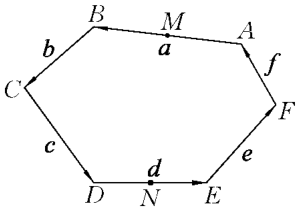
Proof II Let ABCDEF be the given hexagon and let a=AB, b=BC, ..., f=FA. Let M and N be the midpoints of the sides AB and DE respectively. We have MN=21a+b+c+21d and MN=−21a−f−e−21d. Thus we obtain MN=21(b+c−e−f).1◯ From the given property, we have MN=23(∣a∣+∣d∣)≥23∣a−d∣.2◯ Set x=a−d, y=c−f, z=e−b. From ① and ②, we obtain ∣y−z∣≥3∣x∣.3◯ Similarly, we see that ∣z−x∣≥3∣y∣,4◯ ∣x−y∣≥3∣z∣.5◯ Note that 3◯⇔∣y∣2−2y⋅z+∣z∣2≥3∣x∣2, 4◯⇔∣z∣2−2z⋅x+∣x∣2≥3∣y∣2, 5◯⇔∣x∣2−2x⋅y+∣y∣2≥3∣z∣2. By adding up the last three inequalities, we obtain −∣x∣2−∣y∣2−∣z∣2−2y⋅z−2z⋅x−2x⋅y≥0, or −∣x+y+z∣2≥0. Thus x+y+z=0 and the equality holds in every inequality above. Hence we conclude that x+y+z=0, ∣y−z∣=3∣x∣,a∥d∥x, ∣z−x∣=3∣y∣,c∥f∥y, ∣x−y∣=3∣z∣,e∥b∥z. Suppose that PQR is the triangle such that PQ=x, QR=y, RP=z. We may assume ∠QPR≥60∘, without loss of generality. Let L be the midpoint of QR. Then PL=21∣z−x∣=23∣y∣=23QR. It follows from the lemma in Proof I that the triangle PQR is equilateral. Thus we have ∠ABC=∠BCD=⋯=∠FAB=120∘.
Want a route through all this instead of an archive? The track
puts 2,604 problems in a working order, from Junior Challenge level to the IMO shortlist.
Source: MathNet,
licensed CC-BY-4.0.
Statement reproduced verbatim; metadata (topic, difficulty) added by this project.