In triangle , let and be two points on sides and , and let and be two points on segments and , respectively, so that line is parallel to . On ray , beyond , let be a point so that . Similarly, on ray , beyond , let be a point so that . Show that points , and are concyclic.
(Ukraine)
IMO Shortlist, 2019
Solutions — 2
Solution 1
Solution 1. Throughout the solution we use oriented angles.
Let rays and intersect the circumcircle of at and , respectively. By
points are concyclic; denote the circle passing through these points by . We shall prove that and also lie on .
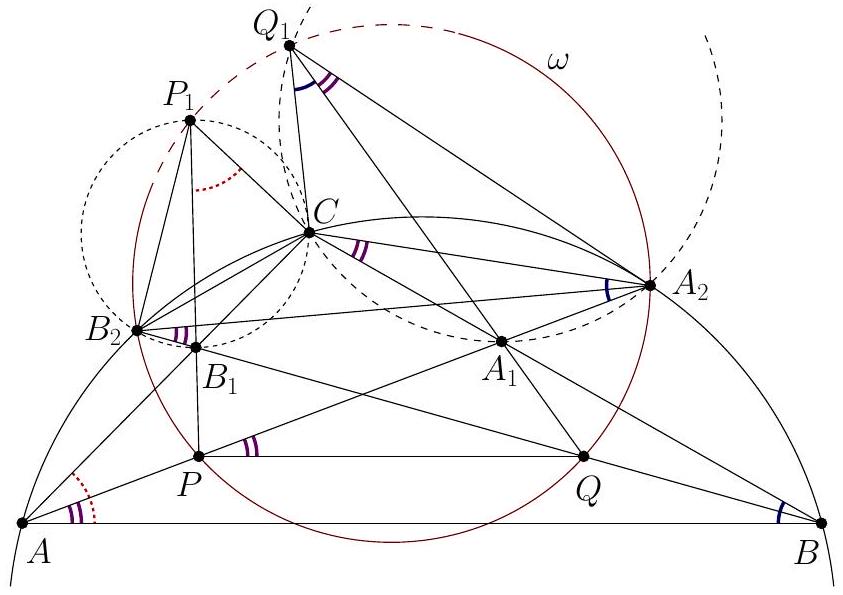
By
points are also concyclic. From that we get
so lies on .
It follows similarly that lies on .
Solution 2
Solution 2. First consider the case when lines and intersect each other at some point .
Let line meet the sides and at and , respectively. Then
so points lie on a circle; denote that circle by . It follows analogously that points lie on another circle; denote it by .
Let and intersect at . Applying Pappus' theorem to the lines and provides that points and are collinear.
Let line meet and at and , respectively. From we obtain
so
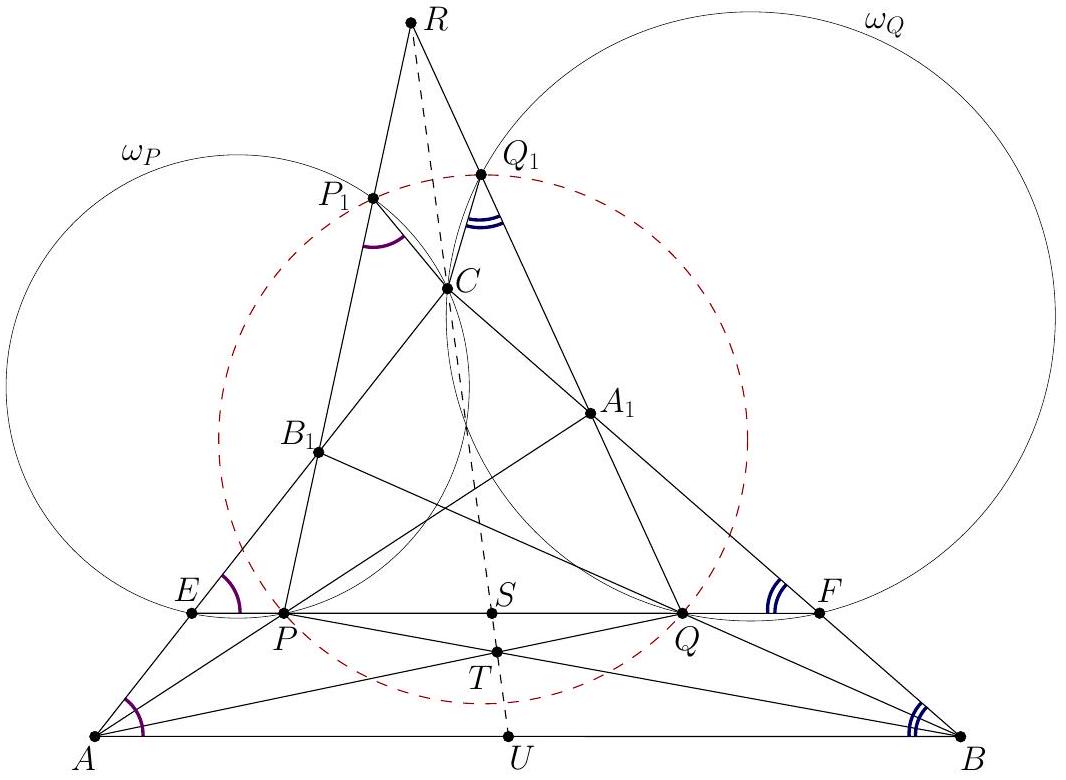
So, point has equal powers with respect to and , hence line is their radical axis; then also has equal powers to the circles, so , proving that points are indeed concyclic.
Now consider the case when and are parallel. Like in the previous case, let and intersect at . Applying Pappus' theorem again to the lines and , in this limit case it shows that line is parallel to and .
Let line meet and at and , as before. The same calculation as in the previous case shows that , so lies on the radical axis between and .
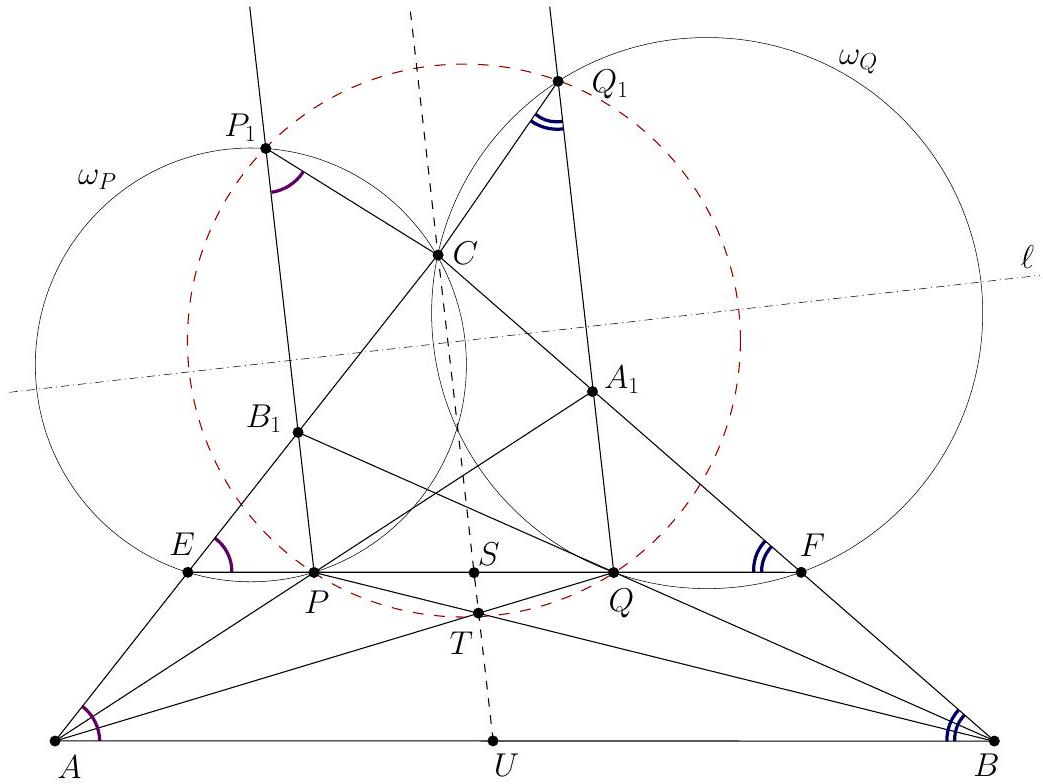
Line , that is the radical axis between and , is perpendicular to the line of centres of and . Hence, the chords and are perpendicular to . So the quadrilateral is an isosceles trapezium with symmetry axis , and hence is cyclic.
Want a route through all this instead of an archive? The track
puts 2,604 problems in a working order, from Junior Challenge level to the IMO shortlist.