a) Let I, X and Y be the midpoints of BC, BE and CF, respectively. Let IX, IY intersect AC, AB at S, T respectively. Since IB is tangent to (ABG), we have
IB2=IG⋅IA=IC2,
so IC is tangent to (AGC) as well. Since I, Y are midpoints of BC, CF, we have IY is parallel to BF, then ∠IYG=∠BFG=∠BAG, and thus A,T,Y and G are concyclic, so IY⋅IT=IG⋅IA.
Similarly,
IS⋅IX=IG⋅IA=IY⋅IT,
implying that A,T,S,Y,X and G lie on the same circle.
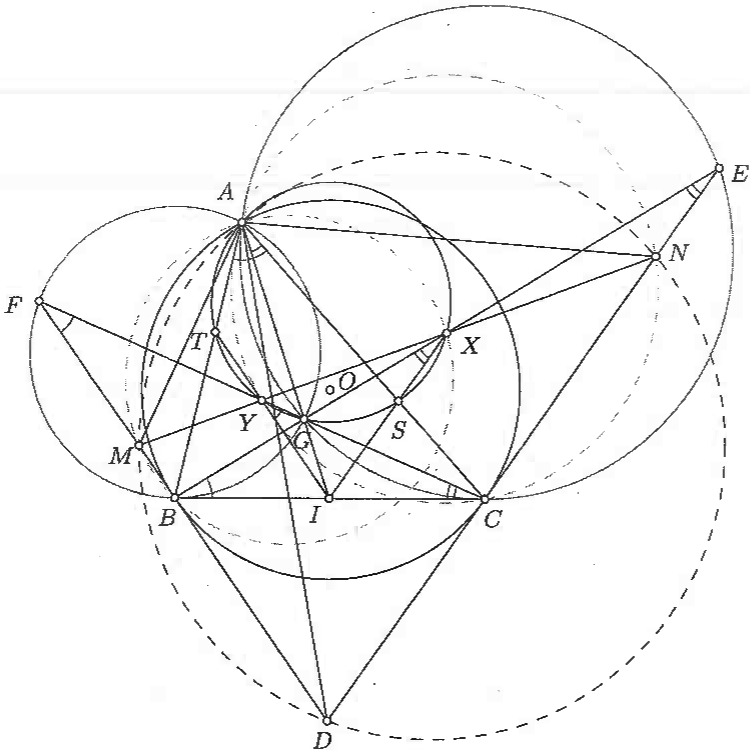
Hence, ∠AXY=∠AGY=∠IGC=∠ACI=∠ABF=∠ABM.
Therefore, A,M,B and X lie on the same circle. Similarly, A,Y,C and N lie on the same circle. Thus, we have ∠AMX=∠GBD,
and ∠NAY=∠GCD. So we have
∠MAN=∠AMX+∠NAY−∠YAX=∠GBD+∠GCD+∠BGC−180∘=180∘−∠BDC,
implying that A,D,M and N lie on the same circle.
b) For a triangle ABC, define the transformation namely γA,△ABC=T∘I, which is the union of the inversion I of center A, power AB⋅AC, and the reflection T through the angle bisector of ∠ABC. First, let prove the following lemma
Lemma. Let ABC be a triangle and (I) be a circle through B,C. Assume that γA,△ABC transforms (I) into (J), then AI,AJ are isogonal with respect to ∠ABC.
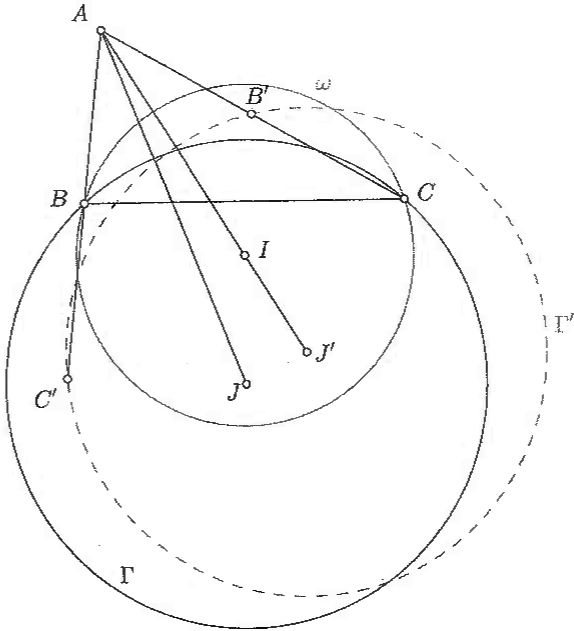
Proof. We have the inversion with center A and power AB⋅AC transforms (I) into (J′), and A,I,J are collinear due to the property of the inversion. Then after the reflection through the bisector of ∠BAC, J′ transforms to J. This implies that AI,AJ are isogonal with respect to angle BAC. □
Back to our main problem, let Oa,Ob and Oc be the centers of (HEF), (HKF) and (HKE). Note that Oa,Ob,Oc are the mutual intersections of the perpendicular bisectors of HK,HE,HF, so the perpendicular bisectors of HK,HE and HF are precisely the lines ObOc,OcOa and OaOb. By Desargue's theorem, R,P and Q are collinear if and only if AOa,BOb and COc are concurrent. So we will show that indeed AOa,BOb and COc concur.
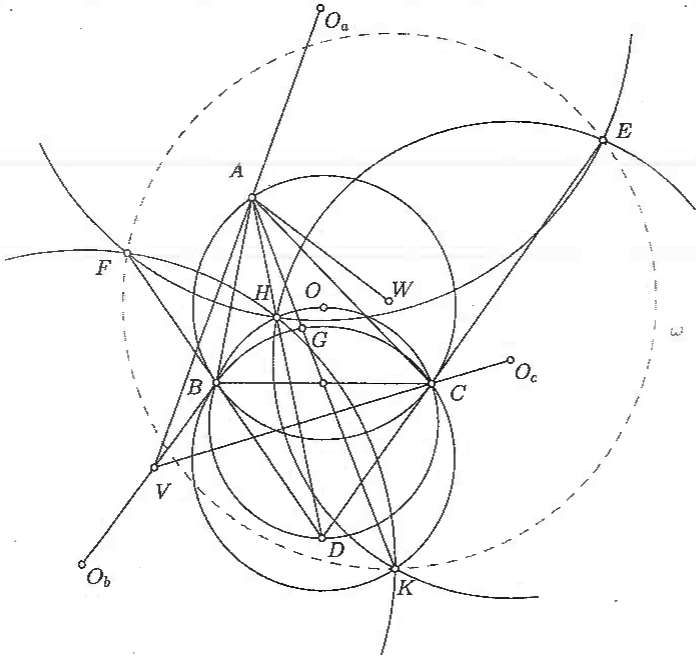
Let W be the center of the circle ω≡(KEF). Now let's consider the transformation γA,△ABC. Since ∠BAD=∠KAC and ∠ABD=180∘−∠C=∠AGC, we have △ABD∼△AGC, and thus
AB⋅AC=AG⋅AD,
and AG,AD are isogonal with respect to ∠BAC. So γA,△ABC turns D to G and vice versa, and hence it transforms (BHC) to (BKC) and vice versa. Since H∈(BHC), K∈(BKC) and AH,AK are isogonal with respect to ∠BAC, the transformation will transform H to K and vice versa. Now, we have
∠ABF−∠ACB=∠KGC=∠AEC,
and similarly ∠ACE=∠AFB, then △AFB∼△ACE, thus
AE⋅AF=AB⋅AC.
Also, since ∠FAB=∠BAC=∠CAE, AE, AF are isogonal with respect to ∠BAC. Hence γA,ΔABC turns E,F to each other and hence it turns (HEF) and (KEF) to each other. By the lemma, we have AOa and AW are isogonal with respect to angle BAC.
Using this similar argument, we can show that γB,ΔABC turns H,E to each other, by noting that △AHB∼△ECB so BA⋅BC=BH⋅BE, and ∠ABH=∠BAG=∠GBC. It also turns F,G to each other since
∠ABF=∠ACB=∠FBC
and △ABF∼△KBC, so BK⋅BF=BA⋅BC. Thus, this transformation turns (HFK) and (EFK) to each other, and by the lemma, BOb,BW are isogonal with respect to ∠ABC. Similarly, we can show that COc,CW are isogonal with respect to ∠ACB. Hence, AOa,BOb and COc will concur on the isogonal conjugate of W with respect to triangle ABC. The proof is completed.
□