a) Let the line passing through A and parallel to BC meet (O) at A0. We have AA0CB is an isosceles trapezoid so A0C=AB=2FHa. We also have ∠FHaB=∠FBHa=∠A0CB then FHa∥A0C. But GC=2GC, it follows that G, A0 and Ha are collinear.
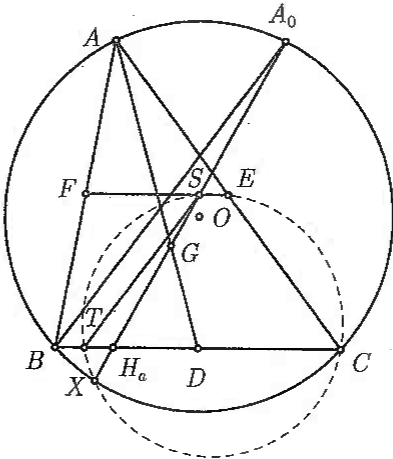
Let S be the midpoint of A0Ha then we have SE∥AA0 so ∠AES=∠A0AC=∠A0XC, which implies SECX is a cyclic quadrilateral.
Let T be the midpoint of BHa then we have ST∥BA0. We obtain ∠XST=∠XA0B=∠XCB and it follows that XCST is a cyclic quadrilateral.
From the above, we have X,C,E,S and T lie on the same circle, thus the circumcircle of triangle XEC passes through the midpoint of BHa.
b) Firstly, we will prove the following lemma.
Lemma. Given triangle ABC with circumcircle (O) and P,Q are two arbitrary points. Lines PA,PB and PC intersect (O) at the second points Pa,Pb and Pc. Lines QA,QB and QC intersect (O) at the second points Qa,Qb and Qc. Lines PaQa,PbQb and PcQc intersect BC,CA and AB at D,E and F respectively. Then the points D,E and F are collinear.
Proof. Using the property of cyclic quadrilaterals, we have
DCDB=PaCPaB⋅QaCQaB.
From there, we obtain that
∏DCDB=∏(PaCPaB⋅QaCQaB)=∏PaCPaB⋅∏QaCQaB=∏sinPACsinPAB⋅∏sinQACsinQAB=1.
Using Menelaus' theorem, we deduce that three points D,E and F are collinear. □
Back to the problem, according to part a), AA0∥BC so XA and XA0 are isogonal with respect to ∠BXC. Let U be the intersection of AX and BC. We have
UCUB⋅HaCHaB=XC2XB2.(1)
It is also well-known that
UCUB=CABA⋅XCBX.
Therefore,
XC2XB2=UC2UB2÷AC2AB2.
Combining with (1), we get
UCUB=UC2UB2÷AC2AB2÷HaCHaB.
Hence,
UCUB=AC2AB2⋅HaCHaB.
Let V be the intersection of BY and CA, W be the intersection of CZ and AB then we have similar equality. Thus,
∏UCUB=∏(AC2AB2⋅HaCHaB)=1.
It follows that AX, BY, and CZ are concurrent at I.
Let A1, B1 and C1 be the symmetric points of A, B and C, respectively, through the midpoints of BC, CA and AB. By simple calculation, we observe that A1X∥DM and GDGA1=3.
Hence the homothety with center G in ratio 3 turns the line DM into a straight line A1X. Similarly, we can prove that this homothety also transforms EN and FP to B1Y and C1Z.
From here, we just need to prove that the lines A1X, B1Y and C1Z are concurrent. Consider triangle XYZ and two points I and G, we have XI, YI and ZI intersect (XYZ) at A, B and C; XG, YG and ZG cut (XYZ) at A0, B0 and C0. Applying the lemma, we have YZ, ZX and XY cut AA0, BB0 and CC0 in three collinear points. Applying Desargues' theorem, we conclude that A1X, B1Y and C1Z are concurrent. □