1) Suppose that we have k triangles in some triangulation. By calculating the sum of all angles of these triangles, we have 180∘⋅k.
The sum of interior angles of A is 180∘⋅98.
The sum of angle around each point among 100 points is 360∘⋅100. Hence, we have
180∘⋅k=180∘⋅98+360∘⋅100⇔k=298.
Each triangle gives 3 edges and among them, there are 100 edges of A. Note that the interior edges are double counted, then the number of edges in each triangulation is
23⋅298−100+100=497.
2) Fix the polygon A, we will prove this problem by induction on m+n of total points, in which n is the number of vertices of A and m is the number of interior points.
For m+n=3, which implies that n=3,m=0, we just have one triangle with no interior point. We color this triangle by some color and finish this case.
For bigger m+n, whenever we add one more point and perform the triangulation, we have two cases:
1. If there are some triangle that share exactly one edge with the polygon A, call triangle X. Then X is adjacent to at most two other triangles then if these two triangles were colored by different colors, we just need to color X by the third color (in case two triangles were colored by the same color, we color X by a random color among the rest). Since X has one vertex that is the interior point, then we can move this point outside as the vertex of A. It is easy to see that polygon A still has n vertices and m decreases by 1. Then we can apply the induction hypothesis.
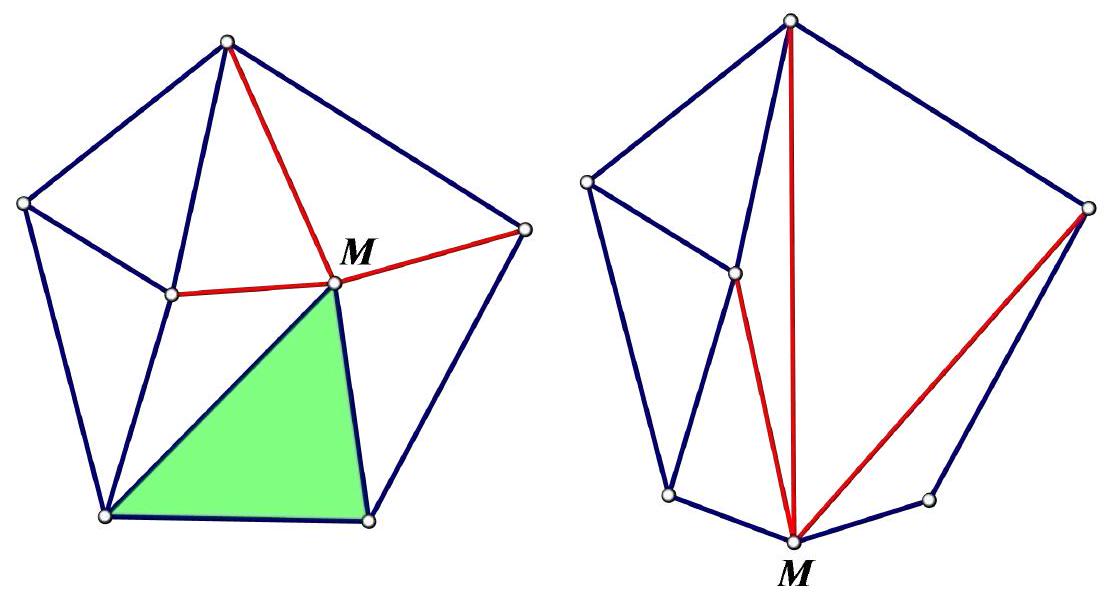
2. If for all triangles X as described above, the vertices of X are not the interior points then X is adjacent to exactly one triangle. We just color X by the color different from the adjacent one and remove the vertex of A to make number of sides of A decrease by 2 and n decreases by 1. Then we can also apply the induction hypothesis.
Therefore, in all cases, we can change the triangulation of m+n points to triangulation of m+n−1 points, which means the problem can be solved by induction completely.
Then we always can draw the triangle by one of three colors that satisfy the given condition. □