Maths Olympiad Prep

Library / /34 of 48

Geometry Difficulty 7.6 National olympiad, round 2 Prove it Asia Pacific Mathematics Olympiad (APMO)

Line \ell intersects sides BCB C and ADA D of cyclic quadrilateral ABCDA B C D in its interior points RR and SS respectively, and intersects ray DCD C beyond point CC at QQ, and ray BAB A beyond point AA at PP. Circumcircles of the triangles QCRQ C R and QDSQ D S intersect at NQN \neq Q, while circumcircles of the triangles PASP A S and PBRP B R intersect at MPM \neq P. Let lines MPM P and NQN Q meet at point XX, lines ABA B and CDC D meet at point KK and lines BCB C and ADA D meet at point LL. Prove that point XX lies on line KLK L.

Solutions — 2

Solution 1

We start with the following lemma.
Lemma 1. Points M,N,P,QM, N, P, Q are concyclic.
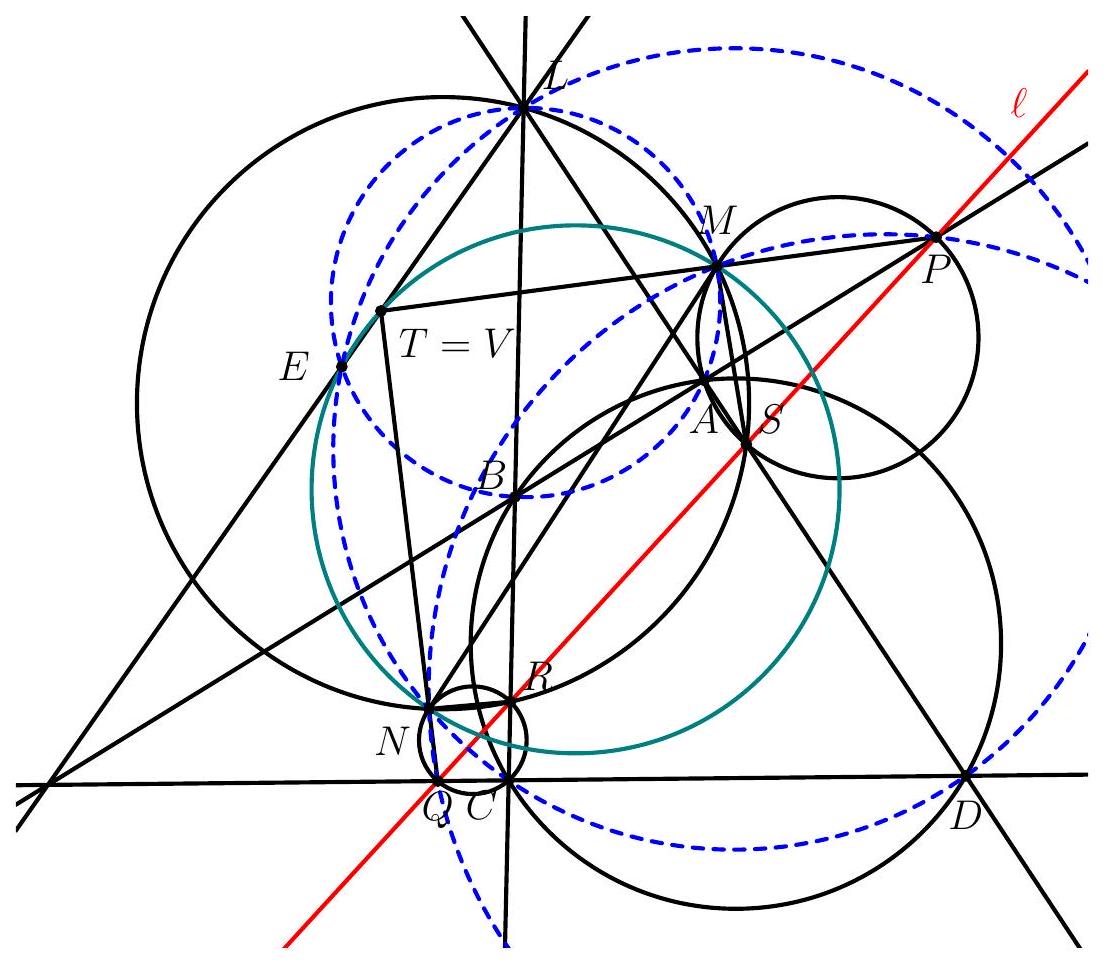
Point MM is the Miquel point of lines AP=AB,PS=,AS=ADA P=A B, P S=\ell, A S=A D, and BR=BCB R=B C, and point NN is the Miquel point of lines CQ=CD,RC=BC,QR=C Q=C D, R C=B C, Q R=\ell, and DS=ADD S=A D. Both points MM and NN are on the circumcircle of the triangle determined by the common lines AD,A D, \ell, and BCB C, which is LRSL R S.
Then, since quadrilaterals QNRC,PMASQ N R C, P M A S, and ABCDA B C D are all cyclic, using directed angles (modulo 180180^\circ )
NMP=NMS+SMP=NRS+SAP=NRQ+DAB=NRQ+DCB=NRQ+QCR=NRQ+QNR=NQR=NQP, \begin{aligned} \measuredangle N M P & =\measuredangle N M S+\measuredangle S M P=\measuredangle N R S+\measuredangle S A P=\measuredangle N R Q+\measuredangle D A B=\measuredangle N R Q+\measuredangle D C B \\ & =\measuredangle N R Q+\measuredangle Q C R=\measuredangle N R Q+\measuredangle Q N R=\measuredangle N Q R=\measuredangle N Q P, \end{aligned}
which implies that MNQPM N Q P is a cyclic quadrilateral.
Figure 1
Let EE be the Miquel point of ABCDA B C D (that is, of lines AB,BC,CD,DAA B, B C, C D, D A ). It is well known that EE lies in the line tt connecting the intersections of the opposite lines of ABCDA B C D. Let lines NQN Q and tt meet at TT. If TET \neq E, using directed angles, looking at the circumcircles of LABL A B (which contains, by definition, EE and MM ), APSA P S (which also contains MM ), and MNQPM N Q P,
TEM=LEM=LAM=SAM=SPM=QPM=QNM=TNM, \measuredangle T E M=\measuredangle L E M=\measuredangle L A M=\measuredangle S A M=\measuredangle S P M=\measuredangle Q P M=\measuredangle Q N M=\measuredangle T N M,
that is, TT lies in the circumcircle ω\omega of EMNE M N. If T=ET=E, the same computation shows that LEM=ENM\measuredangle L E M=\measuredangle E N M, which means that tt is tangent to ω\omega.
Now let lines MPM P and tt meet at VV. An analogous computation shows, by looking at the circumcircles of LCDL C D (which contains EE and NN ), CQRC Q R, and MNQPM N Q P, that VV lies in ω\omega as well, and that if V=EV=E then tt is tangent to ω\omega.
Therefore, since ω\omega meet tt at T,VT, V, and EE, either T=VT=V if both TET \neq E and VEV \neq E or T=V=ET=V=E. At any rate, the intersection of lines MPM P and NQN Q lies in tt.

Solution 2

Barycentric coordinates are a viable way to solve the problem, but even the solution we have found had some clever computations. Here is an outline of this solution.
Lemma 2. Denote by powωX\operatorname{pow}_{\omega} X the power of point XX with respect to circle ω\omega. Let Γ1\Gamma_{1} and Γ2\Gamma_{2} be circles with different centers. Considering ABCA B C as the reference triangle in barycentric coordinates, the radical axis of Γ1\Gamma_{1} and Γ2\Gamma_{2} is given by
(powΓ1ApowΓ2A)x+(powΓ1BpowΓ2B)y+(powΓ1CpowΓ2C)z=0. \left(\operatorname{pow}_{\Gamma_{1}} A-\operatorname{pow}_{\Gamma_{2}} A\right) x+\left(\operatorname{pow}_{\Gamma_{1}} B-\operatorname{pow}_{\Gamma_{2}} B\right) y+\left(\operatorname{pow}_{\Gamma_{1}} C-\operatorname{pow}_{\Gamma_{2}} C\right) z=0 .
Proof: Let Γi\Gamma_{i} have the equation Γi(x,y,z)=a2yzb2zxc2xy+(x+y+z)(rix+siy+tiz)\Gamma_{i}(x, y, z)=-a^{2} y z-b^{2} z x-c^{2} x y+(x+y+z)\left(r_{i} x+s_{i} y+t_{i} z\right). Then powΓiP=Γi(P)\operatorname{pow}_{\Gamma_{i}} P=\Gamma_{i}(P). In particular, powΓiA=Γi(1,0,0)=ri\operatorname{pow}_{\Gamma_{i}} A=\Gamma_{i}(1,0,0)=r_{i} and, similarly, powΓiB=si\operatorname{pow}_{\Gamma_{i}} B=s_{i} and powΓiC=ti\operatorname{pow}_{\Gamma_{i}} C=t_{i}.
Finally, the radical axis is
powΓ1P=powΓ2PΓ1(x,y,z)=Γ2(x,y,z)r1x+s1y+t1z=r2x+s2y+t2z(powΓ1ApowΓ2A)x+(powΓ1BpowΓ2B)y+(powΓ1CpowΓ2C)z=0. \begin{aligned} & \operatorname{pow}_{\Gamma_{1}} P=\operatorname{pow}_{\Gamma_{2}} P \\ \Longleftrightarrow & \Gamma_{1}(x, y, z)=\Gamma_{2}(x, y, z) \\ \Longleftrightarrow & r_{1} x+s_{1} y+t_{1} z=r_{2} x+s_{2} y+t_{2} z \\ \Longleftrightarrow & \left(\operatorname{pow}_{\Gamma_{1}} A-\operatorname{pow}_{\Gamma_{2}} A\right) x+\left(\operatorname{pow}_{\Gamma_{1}} B-\operatorname{pow}_{\Gamma_{2}} B\right) y+\left(\operatorname{pow}_{\Gamma_{1}} C-\operatorname{pow}_{\Gamma_{2}} C\right) z=0 . \end{aligned}
We still use the Miquel point EE of ABCDA B C D. Notice that the problem is equivalent to proving that lines MP,NQM P, N Q, and EKE K are concurrent. The main idea is writing these three lines as radical axes. In fact, by definition of points M,NM, N, and EE :
- MPM P is the radical axis of the circumcircles of PASP A S and PBRP B R;
- NQN Q is the radical axis of the circumcircles of QCRQ C R and QDSQ D S;
- EKE K is the radical axis of the circumcircles of KBCK B C and KADK A D.
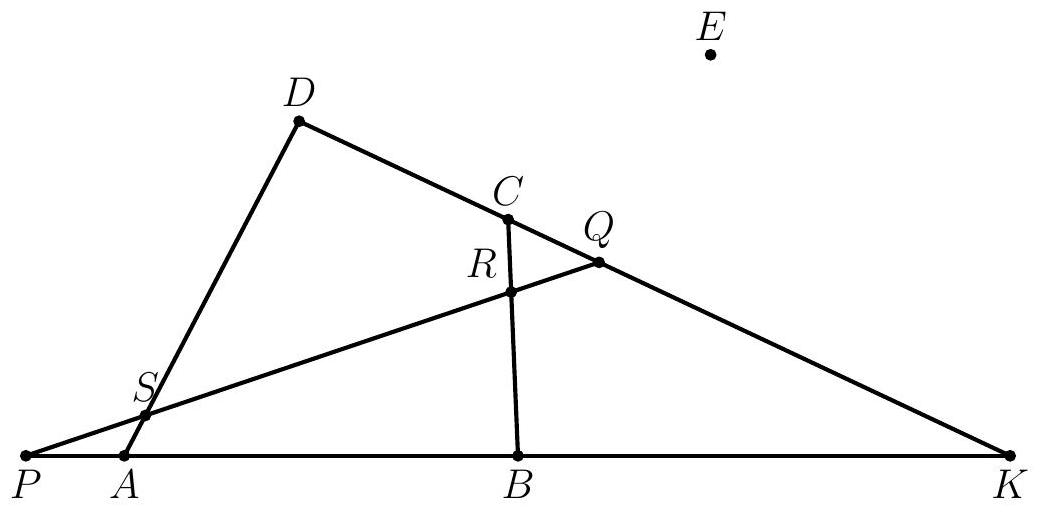
Looking at these facts and the diagram, it makes sense to take triangle KQPK Q P the reference triangle. Because of that, we do not really need to draw circles nor even points MM and NN, as all powers can be computed directly from points in lines KP,KQK P, K Q, and PQP Q.
Figure 2
Associate PP with the xx-coordinate, QQ with the yy-coordinate, and KK with the zz-coordinate. Applying the lemma, the equations of lines PM,QNP M, Q N, and EKE K are
- MP:(KAKPKBKP)x+(QSQPQRQP)y=0M P:(K A \cdot K P-K B \cdot K P) x+(Q S \cdot Q P-Q R \cdot Q P) y=0
- NQ:(KCKQKDKQ)x+(PRPQPSPQ)z=0N Q:(K C \cdot K Q-K D \cdot K Q) x+(P R \cdot P Q-P S \cdot P Q) z=0
- MP:(QCQK+QDQK)y+(PBPKPAPK)z=0M P:(-Q C \cdot Q K+Q D \cdot Q K) y+(P B \cdot P K-P A \cdot P K) z=0
These equations simplify to
- MP:(ABKP)x+(PQRS)y=0M P:(A B \cdot K P) x+(P Q \cdot R S) y=0
- NQ:(CDKQ)x+(PQRS)z=0N Q:(-C D \cdot K Q) x+(P Q \cdot R S) z=0
- MP:(CDKQ)y+(ABKP)z=0M P:(C D \cdot K Q) y+(A B \cdot K P) z=0
Now, if u=ABKP,v=PQRSu=A B \cdot K P, v=P Q \cdot R S, and w=CDKQw=C D \cdot K Q, it suffices to show that
uv0w0v0wu=0 \left|\begin{array}{ccc} u & v & 0 \\-w & 0 & v \\0 & w & u\end{array}\right|=0
which is a straightforward computation.

Want a route through all this instead of an archive? The track puts 2,000 problems in a working order, from AMC 10 level to the IMO shortlist.

Source: MathNet, licensed CC-BY-4.0. Statement and solution reproduced as published; topic and difficulty added by this site.