Maths Olympiad Prep

Library / /35 of 48

Geometry Difficulty 7.7 National olympiad, round 2 Prove it Asia Pacific Mathematics Olympiad (APMO)

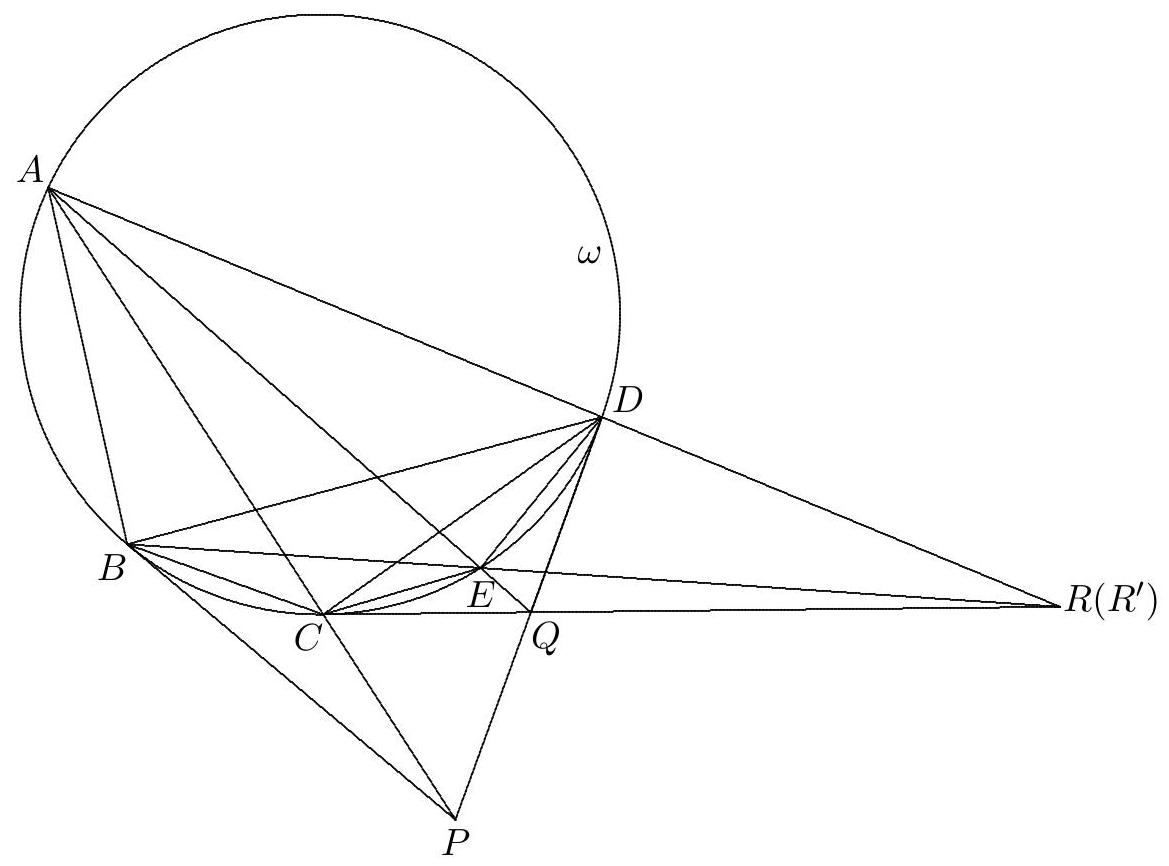
Let ABCDABCD be a quadrilateral inscribed in a circle ω\omega, and let PP be a point on the extension of ACAC such that PBPB and PDPD are tangent to ω\omega. The tangent at CC intersects PDPD at QQ and the line ADAD at RR. Let EE be the second point of intersection between AQAQ and ω\omega. Prove that BB, EE, RR are collinear.

Solution

To show BB, EE, RR are collinear, it is equivalent to show the lines ADAD, BEBE, CQCQ are concurrent. Let CQCQ intersect ADAD at RR and BEBE intersect ADAD at RR'. We shall show RD/RA=RD/RARD / RA = R'D / R'A so that R=RR = R'.

Since PAD\triangle PAD is similar to PDC\triangle PDC and PAB\triangle PAB is similar to PBC\triangle PBC, we have AD/DC=PA/PD=PA/PB=AB/BCAD / DC = PA / PD = PA / PB = AB / BC. Hence, ABDC=BCADAB \cdot DC = BC \cdot AD. By Ptolemy's theorem, ABDC=BCAD=12CADBAB \cdot DC = BC \cdot AD = \frac{1}{2} CA \cdot DB. Similarly CAED=CEAD=12AEDCCA \cdot ED = CE \cdot AD = \frac{1}{2} AE \cdot DC.

Thus
DBAB=2DCCA,(3) \frac{DB}{AB} = \frac{2DC}{CA}, \tag{3}
and
DCCA=2EDAE(4) \frac{DC}{CA} = \frac{2ED}{AE} \tag{4}
Figure 1
Since the triangles RDCRDC and RCARCA are similar, we have RDRC=DCCA=RCRA\frac{RD}{RC} = \frac{DC}{CA} = \frac{RC}{RA}. Thus using (4)
RDRA=RDRARA2=(RCRA)2=(DCCA)2=(2EDAE)2(5) \frac{RD}{RA} = \frac{RD \cdot RA}{RA^2} = \left(\frac{RC}{RA}\right)^2 = \left(\frac{DC}{CA}\right)^2 = \left(\frac{2ED}{AE}\right)^2 \tag{5}
Using the similar triangles ABRABR' and EDREDR', we have RD/RB=ED/ABR'D / R'B = ED / AB. Using the similar triangles DBRDBR' and EAREAR' we have RA/RB=EA/DBR'A / R'B = EA / DB. Thus using (3) and (4),
RDRA=EDDBEAAB=(2EDAE)2(6) \frac{R'D}{R'A} = \frac{ED \cdot DB}{EA \cdot AB} = \left(\frac{2ED}{AE}\right)^2 \tag{6}
It follows from (5) and (6) that R=RR = R'.

Want a route through all this instead of an archive? The track puts 2,000 problems in a working order, from AMC 10 level to the IMO shortlist.

Source: MathNet, licensed CC-BY-4.0. Statement and solution reproduced as published; topic and difficulty added by this site.