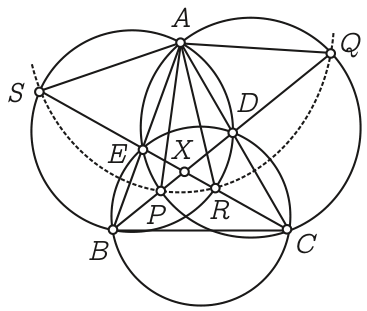
Let ABC be a triangle. An arbitrary circle which passes through the points B and C intersects the sides AC and AB for the second time in D and E, respectively. The line BD intersects the circumcircle of triangle AEC at P and Q, and the line CE intersects the circumcircle of the triangle ABD at R and S, such that P is situated on the segment BD, and R lies on the segment CE. Prove that:
a) the points P,Q,R and S are concyclic;
b) the triangle APQ is isosceles.
Solution
a) Denote by X the intersection of the lines CE and BD. Writing the power of X with respect to all three circles, we obtain: XR⋅XS=XB⋅XD=XE⋅XC=XP⋅XQ. Since {X}=PQ∩RS, we infer that the points P,Q,R and S are concyclic.
b) The triangles ADP and APC are similar (A.A.), thus AP2=AD⋅AC. Similarly, we find that AQ2=AE⋅AB.
From the power of the point A with respect to the circumcircle of the quadrilateral BCDE, we infer that AD⋅AC=AE⋅AB=ρ(A), therefore AP=AQ=ρ(A).
Similarly, we prove that AR=AS=ρ(A), therefore the triangle APQ is isosceles.
Want a route through all this instead of an archive? The track
puts 2,604 problems in a working order, from Junior Challenge level to the IMO shortlist.
Source: MathNet,
licensed CC-BY-4.0.
Statement reproduced verbatim; metadata (topic, difficulty) added by this project.