Let be a non-equilateral triangle such that . Let and be the intersection points of the Euler line of triangle and the sides of the angle . Prove that the triangle is equilateral.
NMO Selection Tests for JBMO
Solution
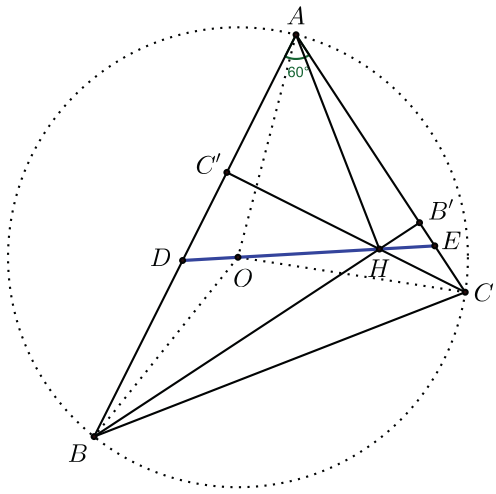
Let and be the orthocenter and the circumcenter of , the radius of the circumcenter; then meets the line at and the line at . Let be the foot of the altitude from and be the foot of the altitude from .
Since is a cyclic quadrilateral we have . Hence , having the similarity ratio . It follows that the similarity ratio is the same with the ratio of the diameters of the circumcircles of triangles and , so , which leads to . (1)
It is known that the rays ( and ( are isogonal, so . (2) From (1) it results that , so . Using (1) and (2), it follows that triangles and are congruent, so and the conclusion follows.
Want a route through all this instead of an archive? The track
puts 2,604 problems in a working order, from Junior Challenge level to the IMO shortlist.