Olympiad Maths Prep

Library / /9 of 11

Geometry Difficulty 6.8 National olympiad Prove it Czech Republic

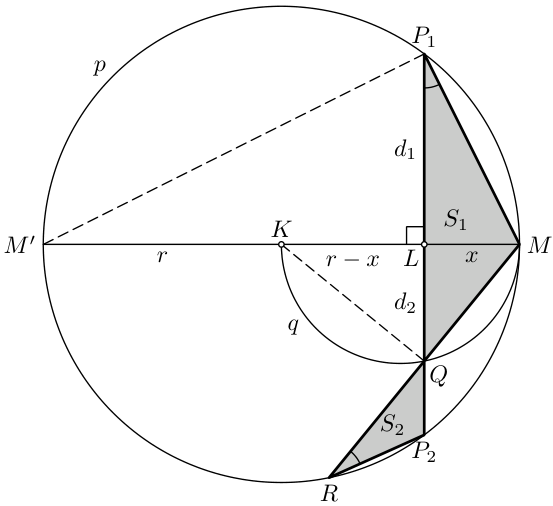
Let pp be a circle with center KK passing through MM, qq a semicircle with diameter KMKM and LL a point inside the segment KMKM. A line through LL perpendicular to KMKM intersects qq at point QQ and pp at points P1,P2P_1, P_2 such that P1Q>P2QP_1Q > P_2Q. Line MQMQ intersects pp for the second time at RMR \ne M. Prove that areas S1,S2S_1, S_2 of triangles MP1Q,P2RQMP_1Q, P_2RQ satisfy
1<S1S2<3+8. 1 < \frac{S_1}{S_2} < 3 + \sqrt{8}.

Solution

The circle containing semicircle qq is the image of pp in homothety with center MM and factor 1/21/2, hence QQ is the midpoint of RMRM. Since triangles MP1QMP_1Q, P2RQP_2RQ share the angle by QQ, we have
S1S2=12P1QMQsinP1QM12P2QRQsinP2QR=P1QP2Q. \frac{S_1}{S_2} = \frac{\frac{1}{2} P_1 Q \cdot M Q \cdot \sin \angle P_1 Q M}{\frac{1}{2} P_2 Q \cdot R Q \cdot \sin \angle P_2 Q R} = \frac{P_1 Q}{P_2 Q}.
Let KM=rKM = r, ML=xML = x, P1L=d1P_1L = d_1, QL=d2QL = d_2 (Fig. 1). Points P1P_1, P2P_2 are symmetric about KMKM, therefore P1L=P2LP_1L = P_2L and P2Q=d1d2P_2Q = d_1 - d_2. Denote by MM' the point such that MMMM' is the diameter of pp. Then triangle MMP1M'MP_1 is right and by Geometric Mean Theorem (an altitude splits a right triangle into two similar triangles) we get d12=x(2rx)d_1^2 = x(2r - x). Similarly in right triangle KQMKQM we get d22=x(rx)d_2^2 = x(r - x) and thus
S1S2=P1QP2Q=d1+d2d1d2=(d1+d2)2d12d22=x(2rx)+x(rx)+2x(2rx)x(rx)rx=3r2x+2(2rx)(rx)r. \begin{aligned} \frac{S_1}{S_2} &= \frac{P_1 Q}{P_2 Q} = \frac{d_1 + d_2}{d_1 - d_2} = \frac{(d_1 + d_2)^2}{d_1^2 - d_2^2} \\ &= \frac{x(2r - x) + x(r - x) + 2\sqrt{x(2r - x) \cdot x(r - x)}}{rx} \\ &= \frac{3r - 2x + 2\sqrt{(2r - x)(r - x)}}{r}. \end{aligned}
Figure 1
Fig. 1
We view the expression as a function of variable xx with parameter rr. The function is decreasing on (0,r)(0, r) (both functions 3r2x3r - 2x and (2rx)(rx)(2r - x)(r - x) are decreasing), therefore it attains its maximum 3+223 + 2\sqrt{2} at x=0x = 0 and minimum 11 at x=rx = r. By the problem statement, x(0,r)x \in (0, r), thus 1<S1/S2<3+22=3+81 < S_1/S_2 < 3 + 2\sqrt{2} = 3 + \sqrt{8}.

Looking for a route rather than an archive? The track puts 2,000 problems in a working order, from AMC 10 level to the IMO shortlist.

Source: MathNet, licensed CC-BY-4.0. Statement and solution reproduced as published; topic and difficulty added by this site.