Olympiad Maths Prep

Library / /10 of 11

Geometry Difficulty 6.8 National olympiad Prove it Czech Republic

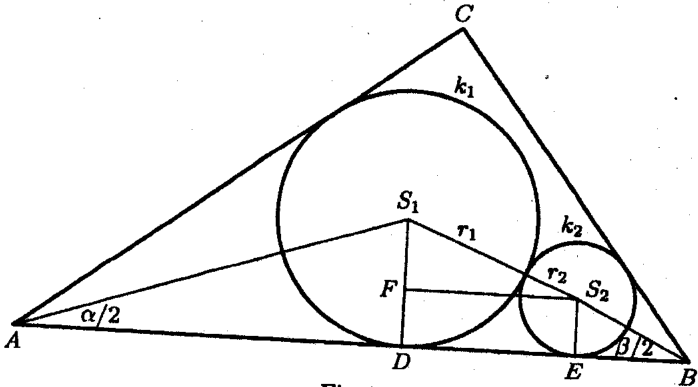
Touching circles k1(S1,r1)k_1(S_1, r_1) and k2(S2,r2)k_2(S_2, r_2) lie in a right-angled triangle ABCABC with the hypotenuse ABAB and legs AC=4AC = 4 and BC=3BC = 3 in such way, that the sides ABAB, ACAC are tangent to k1k_1 and the sides ABAB, BCBC are tangent to k2k_2. Find radii r1r_1 and r2r_2, if 4r1=9r24r_1 = 9r_2. (Pavel Novotný)

Figure 1

Solution

The hypotenuse ABAB has length AB=5AB = 5 with respect to Pythagoras' theorem. Then for angles in the triangle there is cosα=45\cos \alpha = \frac{4}{5}, cosβ=35\cos \beta = \frac{3}{5},
cotα2=1+cosα1cosα=3, \cot \frac{\alpha}{2} = \sqrt{\frac{1 + \cos \alpha}{1 - \cos \alpha}} = 3,
cotβ2=1+cosβ1cosβ=2. \cot \frac{\beta}{2} = \sqrt{\frac{1 + \cos \beta}{1 - \cos \beta}} = 2.

Since both circles k1,k2k_1, k_2 whole lie in the triangle ABCABC, they are externally tangent—in the opposite case the leg tangent to the smaller circle intersects the greater circle. Let circles k1k_1 and k2k_2 touch the side ABAB at points DD resp. EE and let point FF be orthogonal projection of the point S2S_2 to the element S1DS_1D (Fig. 1, under assumption is r1>r2r_1 > r_2). Using Pythagoras' theorem for a triangle FS2S1FS_2S_1 we obtain
(r1+r2)2=(r1r2)2+DE2, (r_1 + r_2)^2 = (r_1 - r_2)^2 + DE^2,
which follows DE=2r1r2DE = 2\sqrt{r_1r_2}.
An equality AB=AD+DE+EBAB = AD + DE + EB gives
c=r1cotα2+2r1r2+r2cotβ2=3r1+2r1r2+2r2, c = r_1 \cot \frac{\alpha}{2} + 2\sqrt{r_1r_2} + r_2 \cot \frac{\beta}{2} = 3r_1 + 2\sqrt{r_1r_2} + 2r_2,
and since r1=94r2r_1 = \frac{9}{4}r_2 we obtain
274r2+3r2+2r2=5, \frac{27}{4}r_2 + 3r_2 + 2r_2 = 5,
which follows
r2=2047,r1=4547. r_2 = \frac{20}{47}, \quad r_1 = \frac{45}{47}.

Looking for a route rather than an archive? The track puts 2,000 problems in a working order, from AMC 10 level to the IMO shortlist.

Source: MathNet, licensed CC-BY-4.0. Statement and solution reproduced as published; topic and difficulty added by this site.