a) We will prove that SM and SN are isogonal in ∠ASB, since (SMN) touches (SAB) and J belongs to the line connecting S and the center of (SAB). Indeed, according to Steiner's theorem for pairs of isogonals, we need to show that
MBMA⋅NBNA=SB2SA2.
On the other hand, since HM and KN are symmedian of triangles HAB and KAB, let Z be the intersection of HK with AB. The left hand side of the above equation can be calculated by
MBMA⋅NBNA=HB2HA2⋅KB2KA2=ZB2ZA2=BE2AF2.
Next, suppose that SR,AR,BR meet AB,RB,RA at R′,F′,E′ respectively. According to Thales's theorem and Ceva's theorem, we have
BEAF=SRAF⋅BESR=SF′AF′⋅SE′BE′=BR′AR′=SBSA.
In short, we get
MBMA⋅NBNA=BE2AF2=SB2SA2.
so SM,SN is isogonal in ∠ASB and the center of (SMN) lies on the fixed line.
b) By the lemma in Problem 3, SE and SF are isogonal with respect to ∠ASB. We will prove that the median at G of the triangle GPQ passing through the fixed point L is the midpoint of the arc CD that does not contain S of (SCD). Rewriting the problem in a more compact form as follows:
Let SAB be a triangle with I is the midpoint AB, any two points C,D on SB,SA. Two points U,V belong to the circumcircle of triangle SAB such that SU,SV is isogonal in ∠ASB and G is the intersection of AU with BV. Let d be the angle bisector ∠ASB, on the line through B and A parallel to d, take the points P and Q satisfying CP∥SU, and DQ∥SV. Let T be the midpoint of PQ. Prove that GT passes through the midpoint L of arc CD that does not contain S of the circumcircle of triangle SCD.
Let K be the second intersection of SL and the circumcircle of triangle SAB, let J be the second intersection of the circumcircle of triangle SCD with the circumcircle of triangle SAB. It is easy to see that TI is the midline of the trapezoid AQPB, so TI∥AQ∥SL. Therefore, by Thales's theorem, we only need to prove that
LKTI=GKGI.
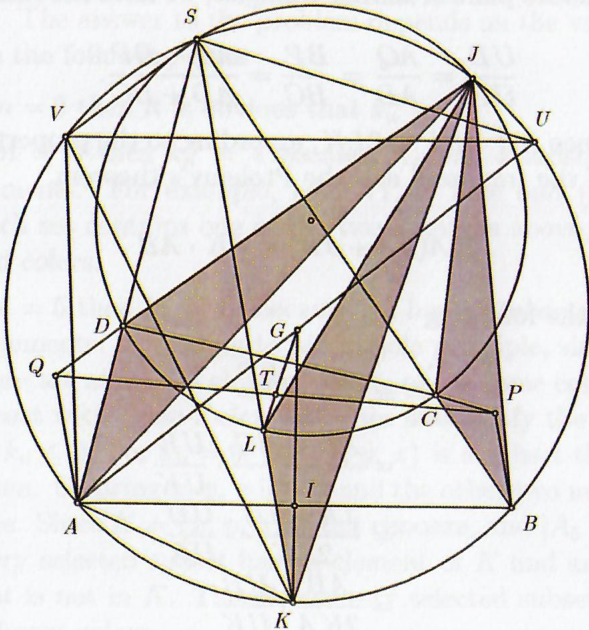
First of all, we have
GKGI=GAGI⋅GKGA=sinGAKsinGKA⋅sinGAI=sinUAKsinUAB⋅sinGKA=UKUB⋅sinGKA.
On the other hand, since
∠QAD=∠KSA=∠AVK and ∠QDA=∠VSA=∠VKA
then △BUK=△AVK∼△QAD and similarly they are similar to △PBC. On the other hand, by the rotation predicate we have
△SAD∼△SKL∼△SBC.
From the above pairs of similar triangles, we have the ratio transformation
UKUB=ADAQ=BCBP=AD+BCAQ+BP.
Finally, since AQ+BP=2LK, according to the property of the midline of the trapezoid and the Ptolemy's theorem,
KA(JA+JB)=JK⋅AB
so we get the following
LKTI=2LKAQ+BP=2LKAD+BC⋅UKUB=2JKJA+JB⋅UKUB=2KAAB⋅UKUB=UKUB⋅sinGKA=GKGI.
So the equality is proved and GT passes through L. Therefore, the median of vertex G in triangle GPQ passes through the midpoint of arc CD which does not contain S of the circumcircle of triangle SCD, which is a fixed point. □