Let be an acute, non-isosceles triangle with circumcircle . , are the heights of , and , intersect at . Let be the midpoint of , and be the point on such that is perpendicular to . A line not going through and parallel to intersects the minor arcs and of at , , respectively. Show that the tangent line of the circumcircle of at , the tangent line of the circumcircle of at , and concur.
Team Selection Tests
Solution
We state the following familiar lemma:
LEMMA. Given triangle and two points . Suppose cuts at and cuts at . Then if and are congruent in then so are and .
We first reduce the problem to a simpler form through pairs of similar triangles. Let be the projection of on . It is easy to see that
so we think of constructing triangle similar to triangle where and are tangent to and .
Let be the intersection of and with . Firstly
infer is on or
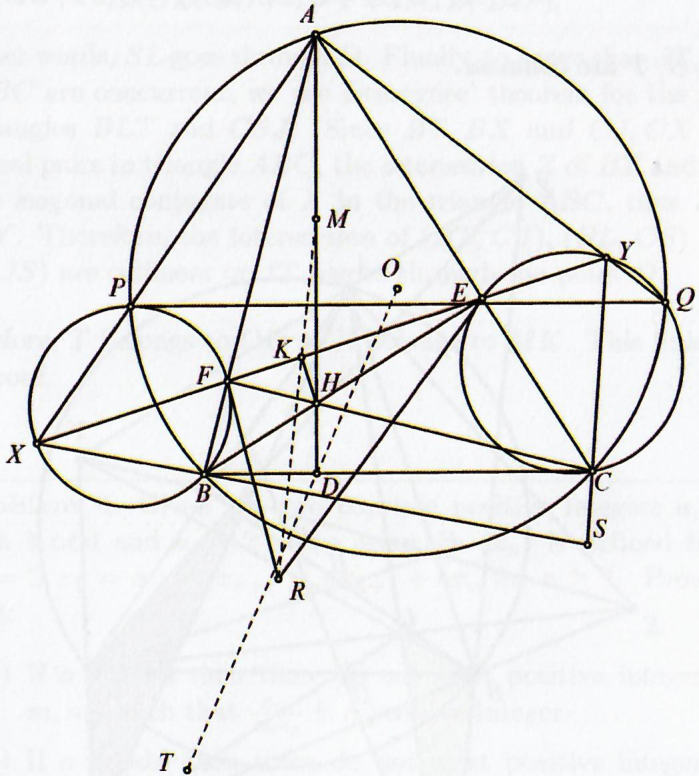
Therefore, if then , is isogonal in and , is isogonal in . In short, if is the intersection of and , then , is isogonal conjugate in triangle .
Let be the intersection of with and the isogonal conjugate of in triangle . We will prove that and lie on . Indeed,
so , , are collinear.
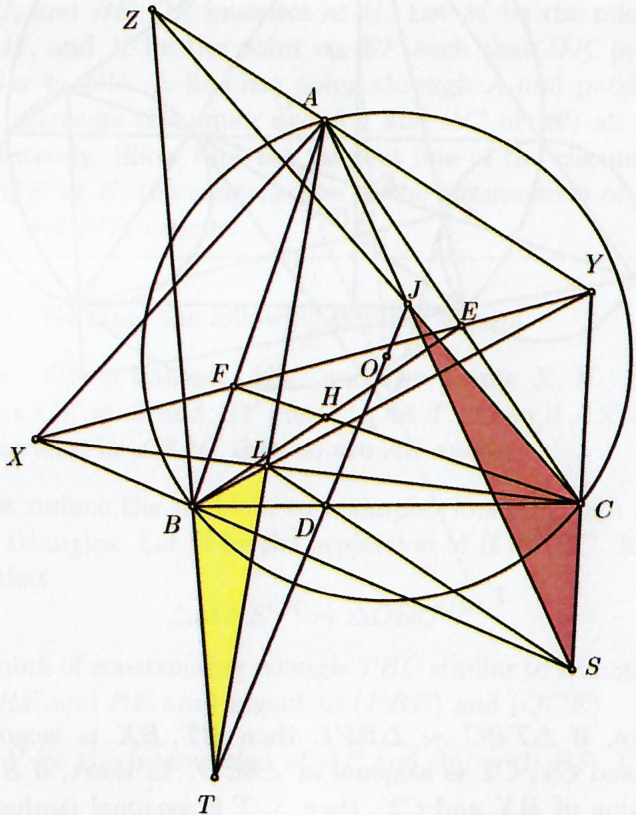
Next, since and are isogonal in , according to the lemma, , isogonal in leads to , , and , , are collinear. Furthermore, in the complete quadrilateral , if intersects at then
in other words, goes through . Finally, to prove that , and are concurrent, we use Desargues' theorem for the pair of triangles and . Since , and , are isogonal pairs in triangle , the intersection of and is the isogonal conjugate of in the triangle , thus is on . Therefore, the intersection of , and are collinear or passes through the point .
Therefore, belongs to so belongs to . This finishes the proof.
Want a route through all this instead of an archive? The track
puts 2,604 problems in a working order, from Junior Challenge level to the IMO shortlist.