Points and are the midpoints of the sides and of the triangle , respectively.
Prove that a circle passing through touches the side if and only if .
(I. Voronovich)
Belarusian Mathematical Olympiad
Solution
Let be the center of the circle passing through ; let be the radius of . Let and be the intersection points of segments and ; let be the foot of the perpendicular from on . Set .
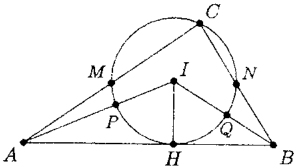
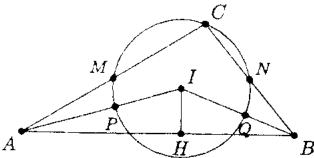
Fig. 3
It is evident that if and only if touches the line ( is a point of tangency. If lies on the side , then (see Fig. 1-3). By the power of a point theorem,
If lies on the side , then . So
It is evident that for from (2) it follows , for from (2) it follows . Therefore, if and only if , i.e. the circle passing through , touches the side .
Want a route through all this instead of an archive? The track
puts 2,604 problems in a working order, from Junior Challenge level to the IMO shortlist.