The squares and are constructed on the bisector of the non-isosceles triangle such that the points and lie in different half-planes with respect to the line .
Prove that the lines , and are concurrent.
Belarusian Mathematical Olympiad
Solution
Denote the points of intersection of the line with the lines and by
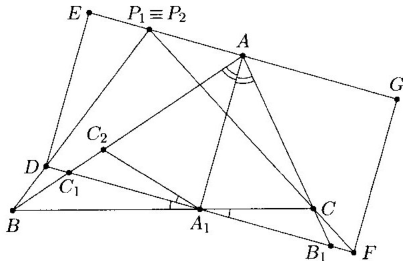
and , respectively. We will prove that . Denote the points of intersection of the lines and with the line by and , respectively. The segment is the altitude and the bisector in the triangle , hence is isosceles with the base and . Without loss of generality, suppose that . If , the lines and intersect the ray , and if , these lines intersect the ray . Therefore, it is enough to prove the equality .
Suppose that (the case can be considered similarly). Then . From follow the similarities and , whence
Therefore, it is enough to prove that . Let be the reflection of through the line . Since is isosceles, the point lies on the segment . From the equalities it follows that the line is the bisector in the triangle . Finally,
Want a route through all this instead of an archive? The track
puts 2,604 problems in a working order, from Junior Challenge level to the IMO shortlist.