Maths Olympiad Prep

Library / /4 of 16

Geometry Difficulty 8.3 Shortlist Prove it IMO

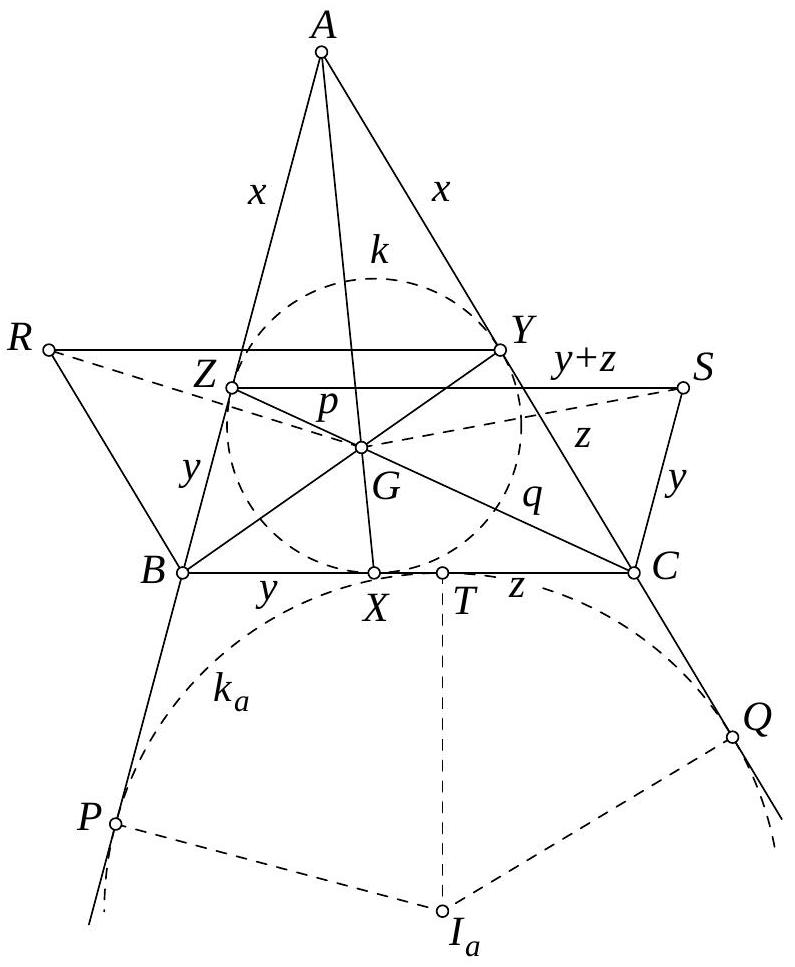
Let ABCABC be a triangle. The incircle of ABCABC touches the sides ABAB and ACAC at the points ZZ and YY, respectively. Let GG be the point where the lines BYBY and CZCZ meet, and let RR and SS be points such that the two quadrilaterals BCYRBCYR and BCSZBCSZ are parallelograms.
Prove that GR=GSGR = GS.

Solutions — 2

Solution 1

Denote by kk the incircle and by kak_{a} the excircle opposite to AA of triangle ABCABC. Let kk and kak_{a} touch the side BCBC at the points XX and TT, respectively, let kak_{a} touch the lines ABAB and ACAC at the points PP and QQ, respectively. We use several times the fact that opposing sides of a parallelogram are of equal length, that points of contact of the excircle and incircle to a side of a triangle lie symmetric with respect to the midpoint of this side and that segments on two tangents to a circle defined by the points of contact and their point of intersection have the same length. So we conclude
ZP=ZB+BP=XB+BT=BX+CX=ZS and CQ=CT=BX=BZ=CS. \begin{gathered} ZP = ZB + BP = XB + BT = BX + CX = ZS \text{ and } \\ CQ = CT = BX = BZ = CS. \end{gathered}
Figure 1
So for each of the points Z,CZ, C, their distances to SS equal the length of a tangent segment from this point to kak_{a}. It is well-known, that all points with this property lie on the line ZCZC, which is the radical axis of SS and kak_{a}. Similar arguments yield that BYBY is the radical axis of RR and kak_{a}. So the point of intersection of ZCZC and BYBY, which is GG by definition, is the radical center of R,SR, S and kak_{a}, from which the claim GR=GSGR = GS follows immediately.

Solution 2

Denote x=AZ=AYx = AZ = AY, y=BZ=BXy = BZ = BX, z=CX=CYz = CX = CY, p=ZGp = ZG, q=GCq = GC. Several lengthy calculations (Menelaos' theorem in triangle AZCAZC, law of Cosines in triangles ABCABC and AZCAZC and Stewart's theorem in triangle ZCSZCS) give four equations for p,q,cosαp, q, \cos \alpha and GSGS in terms of x,yx, y, and zz that can be resolved for GSGS. The result is symmetric in yy and zz, so GR=GSGR = GS. More in detail this means:
The line BYBY intersects the sides of triangle AZCAZC, so Menelaos' theorem yields pqzxx+yy=1\frac{p}{q} \cdot \frac{z}{x} \cdot \frac{x+y}{y} = 1, hence
pq=xyyz+zx. \begin{equation*} \frac{p}{q} = \frac{x y}{y z + z x} . \tag{1} \end{equation*}
Since we only want to show that the term for GSGS is symmetric in yy and zz, we abbreviate terms that are symmetric in yy and zz by capital letters, starting with N=xy+yz+zxN = x y + y z + z x. So (1) implies
pp+q=xyxy+yz+zx=xyN and qp+q=yz+zxxy+yz+zx=yz+zxN. \begin{equation*} \frac{p}{p+q} = \frac{x y}{x y + y z + z x} = \frac{x y}{N} \quad \text{ and } \quad \frac{q}{p+q} = \frac{y z + z x}{x y + y z + z x} = \frac{y z + z x}{N} . \tag{2} \end{equation*}
Now the law of Cosines in triangle ABCABC yields
cosα=(x+y)2+(x+z)2(y+z)22(x+y)(x+z)=2x2+2xy+2xz2yz2(x+y)(x+z)=12yz(x+y)(x+z). \cos \alpha = \frac{(x+y)^2 + (x+z)^2 - (y+z)^2}{2(x+y)(x+z)} = \frac{2x^2 + 2x y + 2x z - 2y z}{2(x+y)(x+z)} = 1 - \frac{2 y z}{(x+y)(x+z)} .
We use this result to apply the law of Cosines in triangle AZCAZC:
(p+q)2=x2+(x+z)22x(x+z)cosα=x2+(x+z)22x(x+z)(12yz(x+y)(x+z))=z2+4xyzx+y \begin{align*} (p+q)^2 & = x^2 + (x+z)^2 - 2x(x+z) \cos \alpha \\ & = x^2 + (x+z)^2 - 2x(x+z) \cdot \left(1 - \frac{2 y z}{(x+y)(x+z)}\right) \\ & = z^2 + \frac{4 x y z}{x+y} \tag{3} \end{align*}
Now in triangle ZCSZCS the segment GSGS is a cevian, so with Stewart's theorem we have py2+q(y+z)2=(p+q)(GS2+pq)p y^2 + q(y+z)^2 = (p+q)\left(GS^2 + p q\right), hence
GS2=pp+qy2+qp+q(y+z)2pp+qqp+q(p+q)2. GS^2 = \frac{p}{p+q} \cdot y^2 + \frac{q}{p+q} \cdot (y+z)^2 - \frac{p}{p+q} \cdot \frac{q}{p+q} \cdot (p+q)^2 .
Replacing the pp's and qq's herein by (2) and (3) yields
GS2=xyNy2+yz+zxN(y+z)2xyNyz+zxN(z2+4xyzx+y)=xy3N+yz(y+z)2NM1+zx(y+z)2Nxyz3(x+y)N24x2y2z2N2M2=xy3+zx(y+z)2Nxyz3(x+y)N2+M1M2=x(y3+y2z+yz2+z3)NM3+xyz2NN2xyz3(x+y)N2+M1M2=x2y2z2+xy2z3+x2yz3x2yz3xy2z3N2+M1M2+M3=x2y2z2N2+M1M2+M3, \begin{aligned} GS^2 & = \frac{x y}{N} y^2 + \frac{y z + z x}{N}(y+z)^2 - \frac{x y}{N} \cdot \frac{y z + z x}{N} \cdot \left(z^2 + \frac{4 x y z}{x+y}\right) \\ & = \frac{x y^3}{N} + \underbrace{\frac{y z (y+z)^2}{N}}_{M_1} + \frac{z x (y+z)^2}{N} - \frac{x y z^3 (x+y)}{N^2} - \underbrace{\frac{4 x^2 y^2 z^2}{N^2}}_{M_2} \\ & = \frac{x y^3 + z x (y+z)^2}{N} - \frac{x y z^3 (x+y)}{N^2} + M_1 - M_2 \\ & = \underbrace{\frac{x\left(y^3 + y^2 z + y z^2 + z^3\right)}{N}}_{M_3} + \frac{x y z^2 N}{N^2} - \frac{x y z^3 (x+y)}{N^2} + M_1 - M_2 \\ & = \frac{x^2 y^2 z^2 + x y^2 z^3 + x^2 y z^3 - x^2 y z^3 - x y^2 z^3}{N^2} + M_1 - M_2 + M_3 \\ & = \frac{x^2 y^2 z^2}{N^2} + M_1 - M_2 + M_3, \end{aligned}
a term that is symmetric in yy and zz, indeed.

Want a route through all this instead of an archive? The track puts 2,000 problems in a working order, from AMC 10 level to the IMO shortlist.

Source: MathNet, licensed CC-BY-4.0. Statement and solution reproduced as published; topic and difficulty added by this site.