Let be a cyclic quadrilateral such that and . Point lies on the line through parallel to such that and lie on opposite sides of line , and . Point lies on the line through parallel to such that and lie on opposite sides of line , and .
Prove that the perpendicular bisectors of segments and intersect on the circumcircle of .
IMO Shortlist
Solutions — 3
Solution 1
Let be the midpoint of and let lines and intersect at and , respectively. Note that lies on the perpendicular bisector of segment .
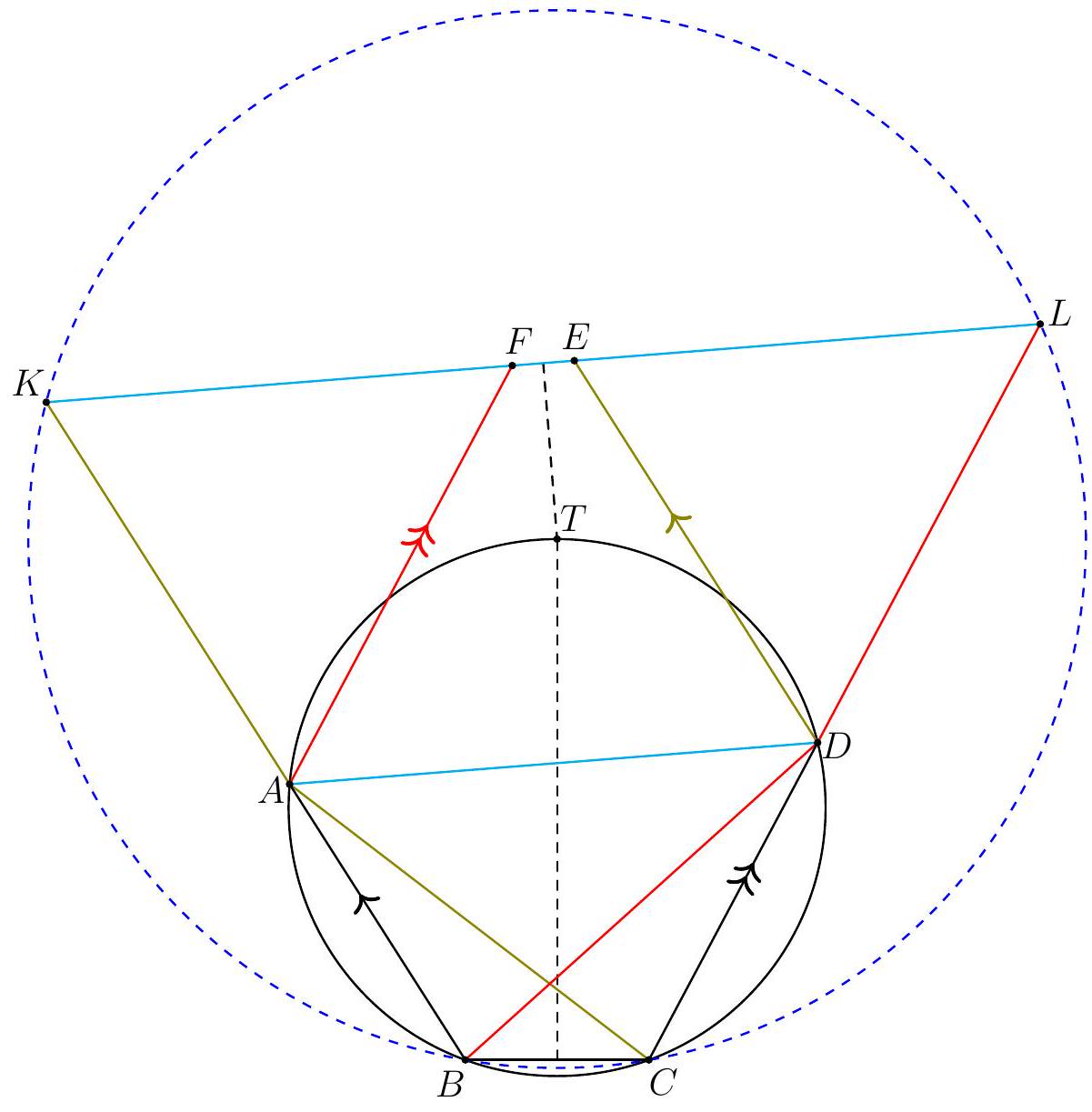
Since is cyclic, . From parallel lines we have and . Hence,
So and are equidistant from the line , meaning that is parallel to .
We have that and are parallelograms, hence we get and . Also, so it suffices to prove the perpendicular bisector of passes through .
Triangle is isosceles so . Likewise, . Since , and all lie on the same side of and lies on the perpendicular bisector of , is the centre of circle . The result follows.
Solution 2
Let and meet at and , respectively, and let be as in Solution 1.
As , and , we have and lies on the opposite side of line to . Also from , we have , and all lie on the same side of the perpendicular bisector of which shows . Combining these, we get and, as and both lie on the same side of line , lies in the interior of segment . Similarly, lies in the interior of segment .
Since is parallel to , we have . Likewise .
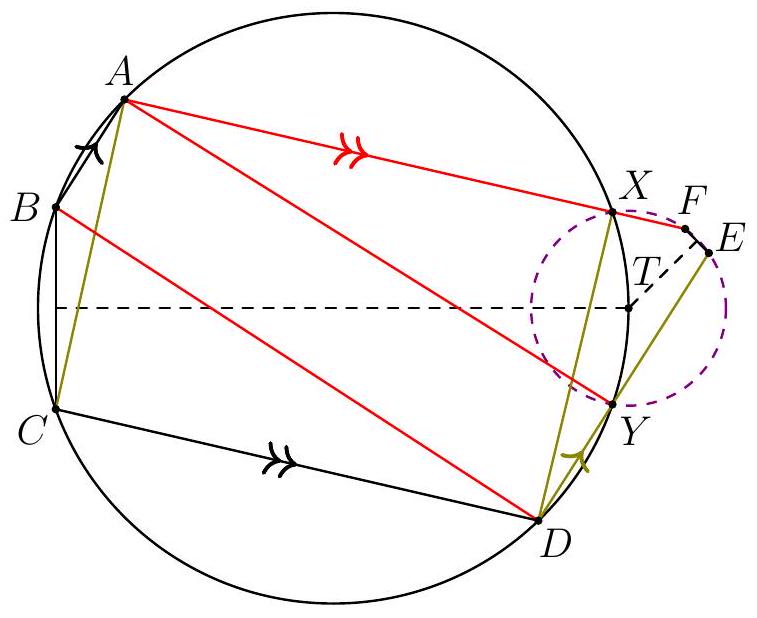
Claim 1. is the midpoint of .
Proof. From and we have
Since is the midpoint of , we have , so
Recall from above we have and analogously, , which shows that and all lie on the same side of line . In particular, and lie on opposite sides of so lies on the internal angle bisector of . Since , we have , giving .
Likewise, , so , meaning that lies on the perpendicular bisector of segment as required.
Solution 3
From , and
triangles and are congruent, so .
Let . Since
we have that lies on circle .
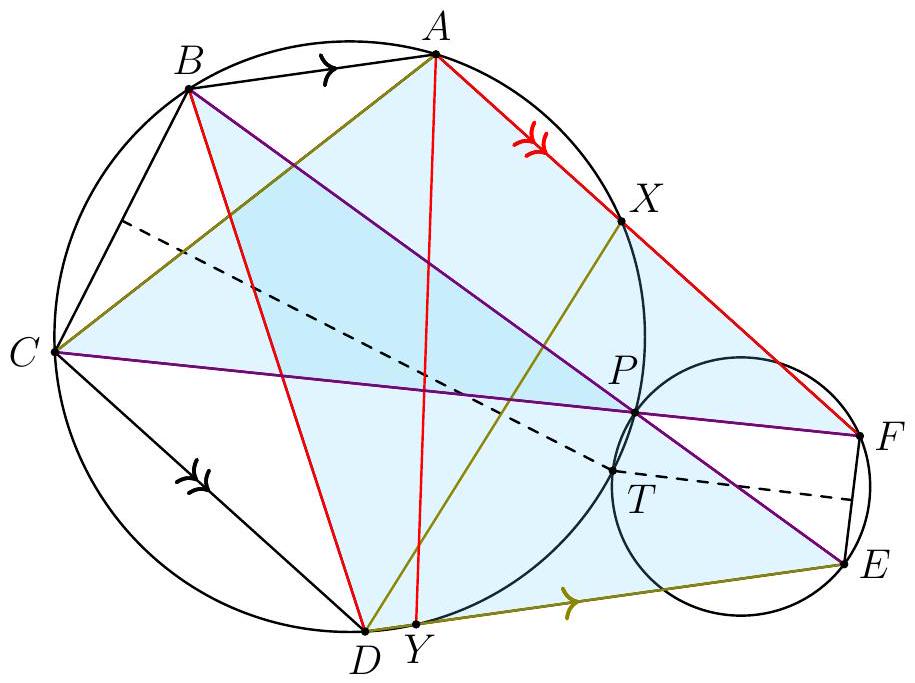
Finally, let be the Miquel point of the quadrilateral so lies on circles and . Note that is the centre of spiral similarity taking segments to and since , this is in fact just a rotation, so and ; that is, the perpendicular bisectors of and meet at , on circle .
Want a route through all this instead of an archive? The track
puts 2,604 problems in a working order, from Junior Challenge level to the IMO shortlist.