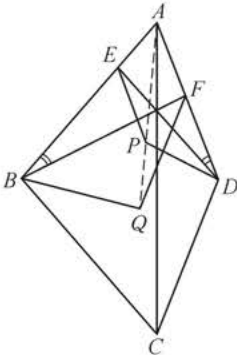
Suppose that the convex quadrilateral ABCD satisfies AB=BC, AD=DC. E is a point on AB, and F on AD, such that B, E, F, D are concyclic. Draw △DPE directly similar to △ADC, and △BQF directly similar to △ABC. Prove that A, P, Q are collinear. (Posed by Ye Zhonghao)
Denote by O the center of the circle that passes through B, E, F, D. Draw lines OB, OF, BD.
Solution
In △BDF, O is the circumcenter, so ∠BOF=2∠BDA; And △ABD∼△CBD, so ∠CDA=2∠BDA. Hence, ∠BOF=∠CDA=∠EPD, which implies that the isosceles triangles △BOF∼△EPD.1◯ On the other hand, the concyclicity of B, E, F, D implies that △ABF∼△ADE.2◯ Combining ① and ②, we know that the quadrilateral ABOF∼ADPE, so ∠BAO=∠DAP.3◯ The same argument gives ∠BAO=∠DAQ.4◯ ③ and ④ imply that A, P, Q are collinear.
Want a route through all this instead of an archive? The track
puts 2,604 problems in a working order, from Junior Challenge level to the IMO shortlist.
Source: MathNet,
licensed CC-BY-4.0.
Statement reproduced verbatim; metadata (topic, difficulty) added by this project.