Maths Olympiad Prep

Library / /21 of 53

Geometry Difficulty 6.0 AIME, harder Prove it China

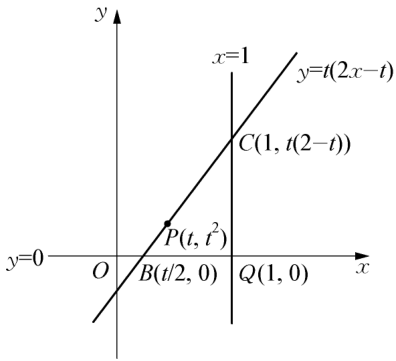
Let AA be the closed domain on the plane delimited by three lines x=1x = 1, y=0y = 0, and y=t(2xt)y = t(2x - t), where 0<t<10 < t < 1. Prove that the surface of any triangle inside the domain AA with P(t,t2)P(t, t^2) and Q(1,0)Q(1, 0) as two of its vertices cannot exceed 14\frac{1}{4}.

Solution

It is easy to observe that the domain is a closed triangle. Its three vertices are B(t2,0)B\left(\frac{t}{2}, 0\right), Q(1,0)Q(1, 0) and C(1,t(2t))C(1, t(2-t)). Pick a point XX inside the BQC\triangle BQC, then the area of PQX\triangle PQX is equal to half of the product of PQPQ with the distance from XX to PQPQ. So the area of PQXPQX
takes its maximum value when the distance from XX to PQPQ is maximized, i.e., when XX coincides with BB or CC.
The area of PQB\triangle PQB is

Figure 1

12(1t2)t2=14(2t)t214(2t)t14(2t+t2)2=14; \begin{aligned} \frac{1}{2}\left(1-\frac{t}{2}\right)t^2 &= \frac{1}{4}(2-t)t^2 \le \frac{1}{4}(2-t)t \\ &\le \frac{1}{4}\left(\frac{2-t+t}{2}\right)^2 = \frac{1}{4}; \end{aligned}
the area of PQC\triangle PQC is
12(1t)(2tt2)=142t(1t)(2t)14(2t+1t+2t3)3=14. \begin{aligned} \frac{1}{2}(1-t)(2t-t^2) &= \frac{1}{4}2t(1-t)(2-t) \\ &\le \frac{1}{4}\left(\frac{2t+1-t+2-t}{3}\right)^3 = \frac{1}{4}. \end{aligned}
Hence, in the domain AA, any triangle with P,QP, Q as two of its vertices cannot have an area that exceeds 14\frac{1}{4}. \square

Want a route through all this instead of an archive? The track puts 2,000 problems in a working order, from AMC 10 level to the IMO shortlist.

Source: MathNet, licensed CC-BY-4.0. Statement and solution reproduced as published; topic and difficulty added by this site.