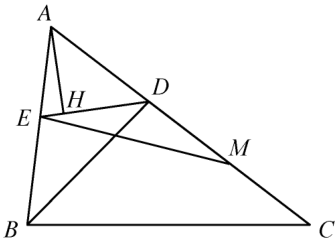
In △ABC with AB=1, let D be a point on AC such that ∠ABD=∠C and let E be a point on AB such that BE=DE. Let H be a point on DE such that AH⊥DE and M be the midpoint of CD. If AH=2−3, find the size of ∠AME. (posed by Xiong Bin)
Solution
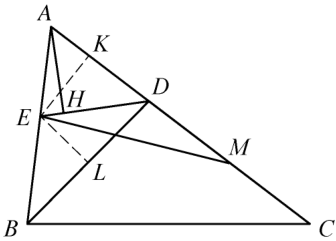
Let ∠ABD=∠C=α and ∠DBC=β. It is easy to see that ∠BDE=α, ∠AED=2α, ∠ADE=∠ADB−∠BDE=(α+β)−α=β, AB=AE+EB=AE+EH+HD. Hence, AHAB=AHAE+EH+AHHD=sin2α1+cos2α+cotβ=cotα+cotβ.1◯ Draw lines EK⊥AC and EL⊥BD with pedals K and L, respectively. Then, L is the midpoint of BD. Combining with the Sine Theorem, we obtain
EKEL=DEsin∠EDKDEsin∠EDL=sinβsinα=CDBD=MDLD. Thus, cotα=ELLD=EKMD=EKMK−EKDK=cot∠AME−cotβ.2◯ By 1◯, 2◯ and known conditions, we have cot∠AME=AHAB=2−31=2+3. Therefore, ∠AME=15∘.
Want a route through all this instead of an archive? The track
puts 2,604 problems in a working order, from Junior Challenge level to the IMO shortlist.
Source: MathNet,
licensed CC-BY-4.0.
Statement reproduced verbatim; metadata (topic, difficulty) added by this project.