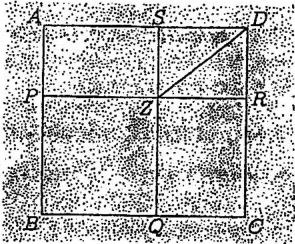
A square is given. Points , , , lie on the sides , , , , of this square, respectively, in such a way that the lines and are parallel and so are the lines and . Let be the point of intersection of the lines and . If , , , determine the length of a side of the square . Here we are denoting the length of a line segment also by .
Japan Mathematical Olympiad
Solution
Let be the length of a side of the square . Then, we have and . Applying the Pythagorean theorem to the right triangle , we get , from which we get . But from we conclude that , and it is easy to check that does satisfy the requirement of the problem.
Want a route through all this instead of an archive? The track
puts 2,604 problems in a working order, from Junior Challenge level to the IMO shortlist.