Maths Olympiad Prep

Library / /16 of 24

Geometry Difficulty 8.5 Shortlist Prove it Romania

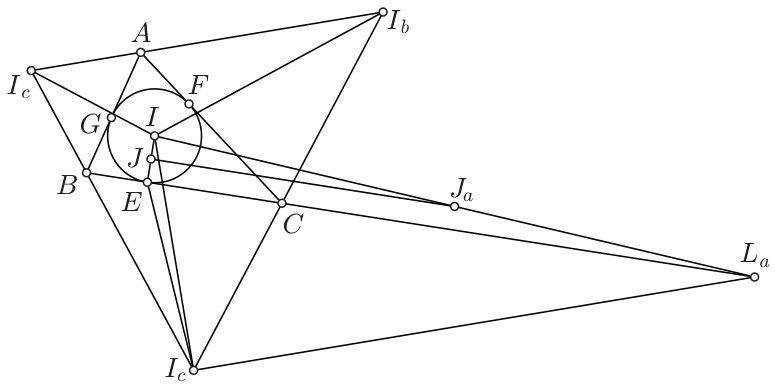
Consider an arbitrary triangle ABCABC with incenter II, and let IaI_a, IbI_b, and IcI_c be the excenters of triangle ABCABC opposite to vertices AA, BB, and CC, respectively, tangent to sides BCBC, CACA, and ABAB. Let EE, FF, and GG be the points of tangency of the incircle with the sides BCBC, CACA, and ABAB, respectively.
Prove that the circumcircles of triangles IEIaIEI_a, IFIbIFI_b, and IGIcIGI_c intersect in a second common point different from II.
Petru Braica

Figure 1

Solution

Denote by JaJ_a, JbJ_b, and JcJ_c the centers of the circumcircles of triangles IEIaIEI_a, IFIbIFI_b, and IGIcIGI_c, respectively. We prove that JaJ_a, JbJ_b, and JcJ_c are collinear.

Let LaL_a, LbL_b, and LcL_c be the points diametrically opposite to II on the circumcircles of triangles IEIaIEI_a, IFIbIFI_b, and IGIcIGI_c, respectively. Since JaJbJ_a J_b, JbJcJ_b J_c, and JcJaJ_c J_a are midlines in triangles ILaLbIL_a L_b, ILbLcIL_b L_c, and ILcLaIL_c L_a, respectively, it suffices to show that LaL_a, LbL_b, and LcL_c are collinear.

Since ILaIL_a is a diameter in the circumcircle of triangle IEIaIEI_a, we have IIaLa=90\angle II_a L_a = 90^\circ. Hence IaLaIIaI_a L_a \perp II_a. But IIaIbIcII_a \perp I_b I_c, so IaLaIbIcI_a L_a \parallel I_b I_c, implying
LaIaB=IaIcIb,andLaIaC=180IaIbIc.(1) \angle L_a I_a B = \angle I_a I_c I_b, \quad \text{and} \quad \angle L_a I_a C = 180^\circ - \angle I_a I_b I_c. \qquad (1)
Let JJ be the midpoint of segment IEIE. Since JJaJJ_a is a midline in triangle IELaIEL_a, it follows that JJaELaJJ_a \parallel EL_a. But JJaJJ_a is the perpendicular bisector of IEIE, so JJaIEJJ_a \perp IE, and since BEIEBE \perp IE, it follows that JJaBEJJ_a \parallel BE. From BEJJaBE \parallel JJ_a and ELaJJaEL_a \parallel JJ_a, we deduce that LaBEL_a \in BE, so LaBCL_a \in BC. Similarly, we deduce that LbCAL_b \in CA and LcABL_c \in AB.

We have BLaCLa=SBIaLaSCIaLa=BIaLaIasin(LaIaB)CIaLaIasin(LaIaC)=(1)BIasin(IaIcIb)CIasin(IaIbIc)\frac{BL_a}{CL_a} = \frac{S_{BI_a L_a}}{S_{CI_a L_a}} = \frac{BI_a \cdot L_a I_a \cdot \sin(\angle L_a I_a B)}{CI_a \cdot L_a I_a \cdot \sin(\angle L_a I_a C)} \stackrel{(1)}{=} \frac{BI_a \cdot \sin(\angle I_a I_c I_b)}{CI_a \cdot \sin(\angle I_a I_b I_c)}.
Similarly, CLbALb=CIbsin(IbIaIc)AIbsin(IbIcIa)\frac{CL_b}{AL_b} = \frac{CI_b \cdot \sin(\angle I_b I_a I_c)}{AI_b \cdot \sin(\angle I_b I_c I_a)}, ALcBLc=AIcsin(IcIbIa)BIcsin(IcIaIb)\frac{AL_c}{BL_c} = \frac{AI_c \cdot \sin(\angle I_c I_b I_a)}{BI_c \cdot \sin(\angle I_c I_a I_b)}.

Therefore, BLaCLaCLbALbALcBLc=1\frac{BL_a}{CL_a} \cdot \frac{CL_b}{AL_b} \cdot \frac{AL_c}{BL_c} = 1, and by the converse of Menelaus' theorem, LaL_a, LbL_b, and LcL_c are collinear, hence JaJ_a, JbJ_b, and JcJ_c are collinear.
It follows that the radical axes of any two of the three circles are parallel or coincide. Since II lies on all three circles, we deduce that these circles have the same radical axis. But IJaJbI \notin J_aJ_b, so the three circles are not tangent, and therefore their radical axis contains a point different from II lying on all three circles.

Want a route through all this instead of an archive? The track puts 2,000 problems in a working order, from AMC 10 level to the IMO shortlist.

Source: MathNet, licensed CC-BY-4.0. Statement and solution reproduced as published; topic and difficulty added by this site.